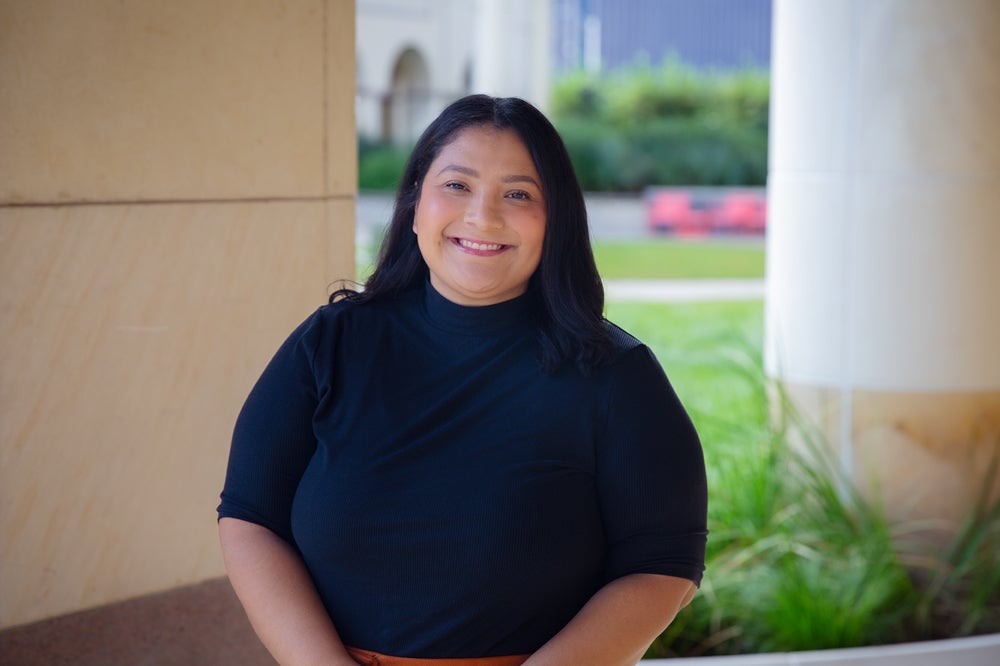
The end of the school year always looked different for Melissa Chavarria. As the daughter of agricultural workers who traveled seasonally across the U.S., she spent the last weeks of school preparing to move to states like Illinois and Michigan for family work opportunities.
By high school, she was invited to take math dual enrollment classes — an opportunity available only to students on an accelerated track at the time. She took these classes without realizing how they could shape her future.
I didn’t recognize the educational capital that opportunities like dual credit represented,
Chavarria said.
Now, as a second-year Ph.D. student in the Department of Educational Leadership and Policy at The University of Texas at Austin, she is looking to help other first-generation students become more aware of available opportunities, transform how students transition from secondary to postsecondary education and improve access for all students.
Breaking Barriers as a First-Generation Student
When she first began exploring her possibilities in higher education, Chavarria realized there were two main barriers that she was facing. The first was personal when she became the first generation in her family to navigate higher education in the U.S. But the second was systemic.
As a first-generation, migrant student from a low-income household, Chavarria recognized that she was given a lot of opportunities because of who she is. But even when she found doors open for her, she realized the systems in place did not provide the necessary information and support for her to utilize ahead of attending a four-year institution.
I was given a lot of opportunities because I was a migrant student, but my goal is to make these opportunities more accessible for all underrepresented students,
Chavarria said.
After earning her bachelor’s degree in political science and sociology from St. Edward’s University, Chavarria began her career as a practitioner doing intervention work with middle school students. Through her daily interactions, it became apparent that students, primarily minority and first-gen, were seldom given guidance on postsecondary pathways.
Her experience inspired her to take on a career integration role as part of a college and career readiness team at a public charter school, where she began to see how policy and higher education structures created additional obstacles for students. Meanwhile, Chavarria began a master’s degree in public administration at the University of Texas Rio Grande Valley. There, she focused on understanding how policymaking and grant funding informed programs students relied on.
I thought my lived experience was unique, and as a practitioner I realized the barriers expand far beyond me,
Chavarria said. When I made the connection that others were also experiencing these issues, I wanted to know if the problem was at the program, policy, institution or state level.
Researching Postsecondary Pathways
Chavarria decided to pivot her career and joined a nonprofit research organization, sparking her passion for investigating gaps in secondary-to-postsecondary transitions.
Looking to combine her interests, Chavarria was drawn to the College of Education at UT Austin’s Higher Education Leadership and Policy Program and the program’s focus on the K-20 pipeline. The graduate program allowed her to research both the higher education and K-12 education fields and further explore the transition between secondary and post-secondary schooling.
I identified the College of Education’s passion to not just move forward policy but also help practitioners understand the policy and how it affects them – especially those working with marginalized communities,
Chavarria said.
Building Stronger K-12 and Community College Partnerships
As she applied her personal and practitioner experience to an education policy degree, Chavarria became determined to create research that informs formalized partnerships between K-12 schools and community colleges.
Currently, community colleges act as one of the main providers of dual credit classes for K-12 institutions, but there is no clear college advising structure built into these partnerships. She envisions a system where community colleges can proactively provide advising and create clear pathways that build students’ transfer capital to four-year institutions.
Having taken dual enrollment classes, I know exactly the impact these programs have on students both educationally and personally,
Chavarria said. They helped me feel more confident going into college because I already had a small exposure to higher education.
Additionally, as a practitioner she noticed inequities in access to opportunities such as dual credit, where students enrolled are typically high performing or have previously been exposed to higher education. By strengthening K-12 and community college partnerships, a pathway can be open to help all underrepresented students achieve their postsecondary goals.
As I learned more about the early college high school system, I became very interested in how community colleges play a part in making early college high schools successful,
Chavarria said. Having a formalized partnership system in place between the two could ensure resources are focused on advising and recruiting students who do not see themselves as eligible candidates for a postsecondary pathway.
Through her work with Lauren Schudde on the Dual Enrollment Pathways (DEEP) Framework, Chavarria is using her research to understand early college and dual credit systems and how community colleges and K–12 schools can collaborate to effectively support students.
Making Research Accessible for Change
For Chavarria, her goal is to make sure her research reaches at least one educator or policymaker who can use it and give her suggestions a try.
My goal is to make our research accessible to practitioners and relatable,
she said. Every small change can create a bigger impact. If it doesn’t work, we adjust. But if it does, we can make an impact, step by step.