When Armando Lizarraga graduated high school, he enrolled in community college at the behest of a friend. But the experience was short lived. His focus was clouded with a need to provide for and support his family as he dealt with the devastating impact of his dad’s incarceration.
I was not living to succeed,
Lizarraga said. I was living to survive.
Years later, he returned to community college in his late twenties, tired of taking entry-level positions and ready to change his life for the better.
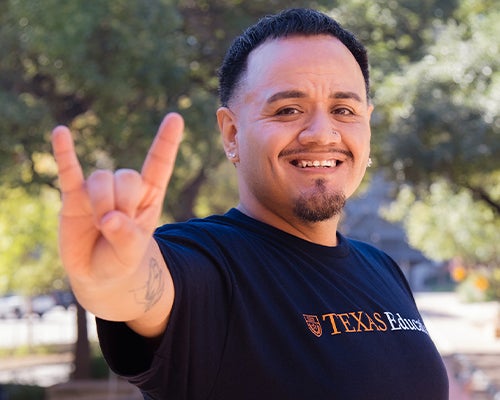
Now, the first-generation doctoral candidate who expects to earn his Ph.D. in Education Leadership and Policy next year is set to become the first in his family to complete the highest level of higher education as he prepares to serve a community close to his heart — students affected by the carceral system. Lizarraga hopes to continue his years-long research on ways to improve education access for those incarcerated or formerly incarcerated, particularly women of color, as a form of reentry into society.
From an early age, I learned to navigate systems that most children don’t,
Lizarraga said. I think it is those early experiences that taught me how to engage with and navigate in these spaces and made me more aware of little things which help me understand this community.
Looking back, Lizarraga credits his success to a life-changing conversation with a community college professor who saw more potential in him than he did and encouraged him to apply to transfer to the University of California, Los Angeles.
After participating in a mentor program designed to help community college students in California transfer to a University of California campus, he enrolled as a Chicano/Chicana studies major at UCLA and eventually added sociology to his degree too. During his time there, he became involved with an organization aimed at serving formerly incarcerated students or students impacted in other ways by the carceral system.
A friend suggested that I attend a meeting, but at first I did not think this was my space because I am not formerly incarcerated,
Lizarraga said. I did not know how I could contribute, but my friend reassured me that I was just as impacted because my father had been detained and reaffirmed this was a space for me.
During those meetings, Lizarraga recalls being able to examine and understand for the first time how his father’s incarceration impacted his education journey.
I am Mexican and within Latino culture we don’t talk about our problems, particularly things like this,
Lizarraga said. It wasn’t until this club that I started to unpack what that meant for my family and my education, and I began to get involved in advocating for students who were incarcerated and formerly incarcerated and leaning into education as a way to reintroduce themselves to society.
In his time at UCLA, Lizarraga also remembers taking a class on Mexican Americans in education which featured a text from Dr. Victor Saenz titled, The Vanishing Latino Male in Higher Education.
Lizarraga said the book spoke to him and inspired his research trajectory. Little could he have imagined he would meet Dr. Saenz, College of Education Associate Dean for Student Success, Community Engagement, and Administration and a professor in Education Leadership and Policy, on the path to his Ph.D.
Upon graduating from UCLA, he went on to complete his master’s degree at the teacher’s college at Columbia University. Attending the college felt like a dream come true after visiting the campus for the first time during his undergraduate years to attend Columbia’s Center for Justice conference titled Beyond the Bars.
It was attending that annual event that Lizarraga said furthered his passion for making a difference in educational access for those affected by incarceration.
At Columbia, he began working with the community college research center and a community impact organization which provided needs-based support to community members in the Harlem area, such as teaching English courses, computer literacy, and helping people obtain their GED.
His role included attending the English courses to speak with students about whether they needed any support services, such as medical or social work services to meet their basic needs.
There, I started to become aware that many folks were undocumented or from incarcerated foster youth programs,
Lizarraga said. It was a very diverse group of people for whom I was trying to find support systems while also teaching math to students ages 15 to 60.
When the COVID-19 pandemic began, he left New York to return home but continued teaching virtually as he and other members of the organization worked to find resources like laptops and hotspots for community members to continue their education.
As Lizarraga evaluated the next stop in his academic career, a friend asked if he was applying to The University of Texas at Austin’s doctoral programs and offered to make an introduction for him with Dr. Saenz. Lizarraga excitedly took the opportunity to meet with the author who had so deeply inspired him in hopes of seeing if their research aligned and what that meant for his academic future.
It was a very full circle moment because I had read about him and now we were in the same room talking about similarities in our work,
Lizarraga said. Back then, I would have never imagined he would know who I am.
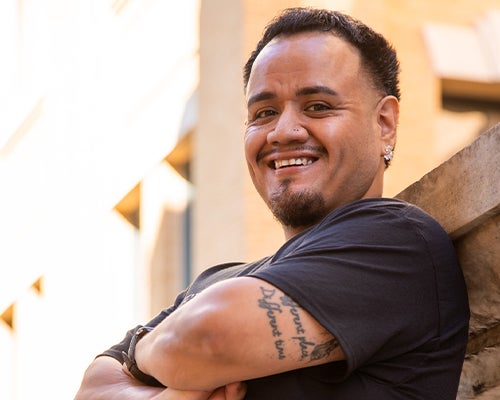
Upon arriving at COE, Lizarraga knew that UT Austin had a prison education program and quickly became involved as a volunteer. Eventually, he became director of pedagogy and practice, a role in which he supported teachers who were teaching within prisons on appropriate teaching styles, ways to improve curriculum, and ensuring that deficit language was not part of the curriculum.
Instead of saying homework, we call it assignment because that is not their home,
Lizarraga said. Winter break is a break for us because we get to go home, but they don’t, so framing language is really important.
Then, Lizarraga went on to work with non-profit Texas Appleseed on prison education and researching equitable access for incarcerated people. It was through this role that Lizarraga said he came to his current line of work and study.
My dissertation primarily focuses on women and how they experience education while incarcerated and in reentry to society,
Lizarraga said. When I started to go in, I saw how women were leaning into education as a way to reintroduce themselves to society and realized that a lot of what I was reading was very centered on the experience of white males.
Seeing the diversity of the incarcerated population made Lizarraga question how representative current texts were about the experience of minority populations. Additionally, he was inspired by the research he did with Dr. Saenz as part of COE’s Project Males research initiative to explore ways to understand the experience of women of color impacted by incarceration with education.
A lot of folks who reenter society after incarceration will most likely do so after community college,
Lizarraga said. When we talk about students transferring from community colleges, we also have to consider the formerly incarcerated community and how we can support them having the same access to transfer pathways as others.
His passion for the subject became evident to UT Austin faculty, who began sending him related opportunities and fellowships as they came up. This led to Lizarraga having financial support to attend conferences, request prison data and receive both the continuing education fellowship and the Harrington Fellowship.
Our faculty have really supported my work pushing back on how we think about education and who has the privilege to access it,
Lizarraga said. It came at a time when I needed validation and an affirmation that my work is valid and appreciated.
As he finishes his fifth year at UT Austin and looks forward to his future following his Ph.D., Lizarraga said his hope is to become faculty at a university or community college and be an example for others with similar past experiences that there is a place for them in higher education.
I want to make sure students feel seen, heard, represented and that they have someone on the other side,
Lizarraga said. When we talk about education, I hope we can begin to reimagine where education happens because it doesn’t just happen at an institution. It doesn’t just happen at UT. It happens anywhere and a lot of people don’t know there is education in the carceral system.
He added that his dream now is to create a research lab to put theory into practice and create programming that allows incarcerated people to obtain a degree while incarcerated or leave prison with a pathway to transition to a college campus. Lizarraga said he would also like to create support centers to provide resources and information for people reentering society.
Looking to the future, he said he hopes his research will become a springboard to think about communities we often don’t think about and how to make access to education equitable for them.
We all make mistakes, and I hope that through this we can humanize people,
Lizarraga said. That is why I am very open and candid about my experience, because it is not until you put a face and a name to something that you become a bit more sympathetic.
Reflecting on the impact that education made in his life, Lizarraga said his overarching goal is to help others reinvent themselves through academia in the same way that he was able to because a professor believed in him.
I am the first one in my family to go this far,
Lizarraga said. I want to celebrate and give back. This has never been about me — my degree and my work. It has always been beyond me.