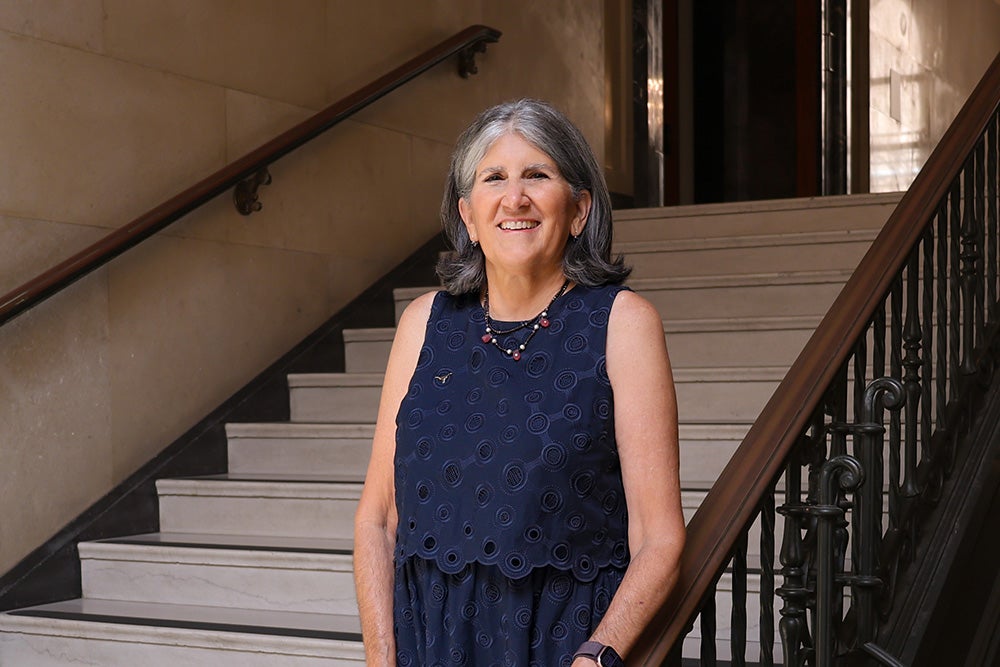
Mary Steinhardt attributes her decades of career success to a straightforward but powerful drive: serving others.
I’ve said ‘Yes’ to most requests that come my way,
says Steinhardt.
Over the years, that’s included developing wellness and resilience programs in the corporate world, including for 3M, Motorola Solutions Inc., Dell Inc. and Applied Materials Inc. She’s also worked with or studied UT’s Division of Housing and Food, U.S. Army post Fort Hood, the City of Austin Police Department Wellness Office, Texas Department of Aging and Disability Services and public schoolteachers.
For her own education, Steinhardt earned a bachelor’s in health and physical education from the University of North Carolina at Chapel Hill, master’s in health education from Lamar University in Beaumont, Texas, doctorate in education from the University of Houston and master’s in counseling from Southwest Texas State University (now Texas State University) in San Marcos.
Today, Steinhardt is a professor in the College of Education’s Department of Kinesiology and Health Education as well as The University of Texas at Austin’s associate vice president for research and research integrity officer. In her own scholarship, Steinhardt focuses on stress, coping and resilience.
We recently spoke to Steinhardt about her research, commitment to service, research integrity officer role and more.
Being open to opportunities has always been important for you, but your work on diabetes in Austin was something you more actively pursued. Why is that?
Diabetes runs in my family: My dad had below-the-knee amputations. I grew up in North Carolina, both my parents were schoolteachers and we had women in our home—Cremo and Viola Hall—who raised me and were like family. If you’ve read The Help,
I could have written that book. So, I thought, I’m going to address diabetes in Austin’s African American community.
I got a small grant from the School of Nursing and ran a couple of pilots.
Starting in 2015, you were awarded a National Institutes of Health grant for research on this topic. How did that come about?
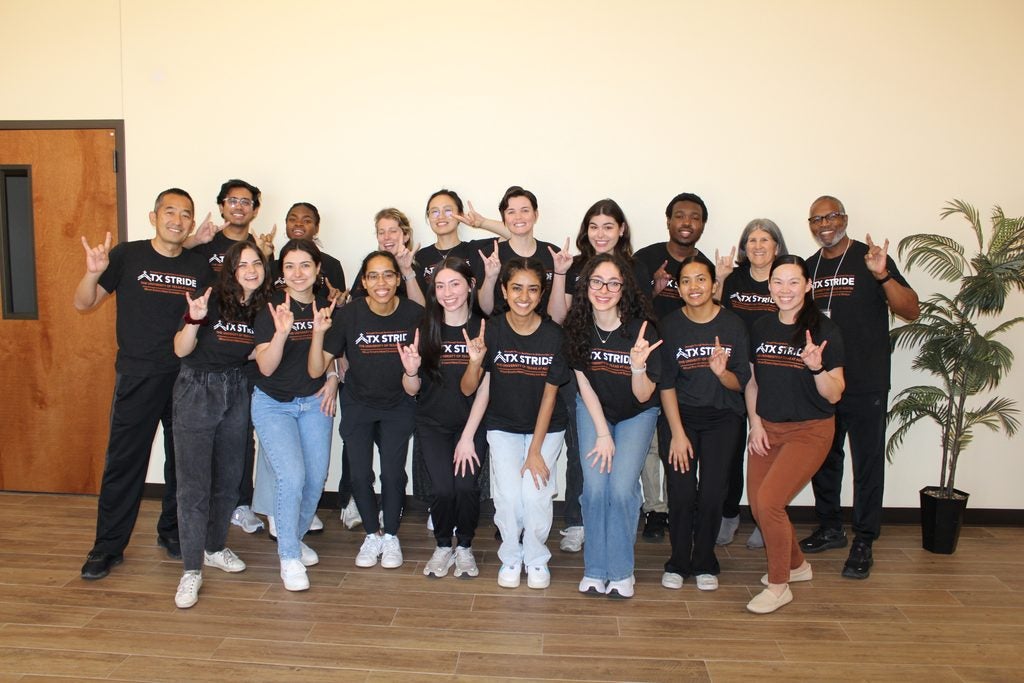
I wanted to apply for an NIH grant before I retired. My department in the College of Education had hired a person to help faculty with grants: My grant didn’t get funded at first, but then it did, an R34. And then I got a big grant—an R01. I loved the work.
My grant from NIH is officially over today, and I have three months to write my final report. How about that? Viola and Cremo would be so proud of me.
Based on your research, what did you find?
The assumption is that, since Type 2 diabetes is a chronic disease, it’s a chronic stressor. So, if you teach people how to adapt more effectively to stress, they can better handle their chronic disease. In the study, everybody was provided a regular diabetes program—diabetes self-management education and support—and one group got resilience strategies infused into their diabetes education.
We followed people for two years. Both groups improved their depressive symptoms after the program, but the resilience-based group had sustained improvements in depressive symptoms at two years and more favorable glycemic control over time compared with the group that just received diabetes education.
Speaking of scholarship, you’re UT’s research integrity officer. What does that role involve?
All allegations of campus research misconduct—from anybody external or internal to the university—come to the RIO office. Any institution that receives federal funds must have an RIO. Our policy is aligned with federal regulations, so that research misconduct involves fabrication, falsification or plagiarism. Fabricating means making up data or results; falsification is changing or manipulating data in some way, like a figure or a table; and plagiarism is presenting as your own the words, ideas, processes or results of another person without proper attribution.
We try to figure out what issues researchers are having and do as much prevention as we can. For example, a lot of what came into the RIO office was not fabrication, falsification or plagiarism, but more of an authorship dispute. So, we made a responsible authorship guidance document to educate our research community, and we pass it out at the new faculty orientation, to new administrators and everywhere else we go. We also put it on our website.
When a researcher is accused of misconduct, what happens next?
When an allegation comes in, we do an assessment. If it seems credible and specific, we move to an inquiry. The RIO gathers preliminary evidence, may do interviews and then decides whether to close the case or move to an investigation. During an investigation, we get a committee of three faculty members who do a formal investigation, write a report on whether research misconduct occurred and make any recommendations. We submit their report to the provost, who’s the deciding official.
How do you feel about the work?
I enjoy it. If someone is accused of research misconduct, maybe they can realize they’ve made a mistake, face the potential administrative action, and get back on the right track.
All dissertations now come to the RIO office. Even though this is often an adverse situation for faculty and students, I take great pride in being kind and compassionate in this role.
That’s important. In 2017, you were honored with the Civitatis Award, the highest distinction made by the University in recognition of outstanding faculty citizenship. What did that mean to you?
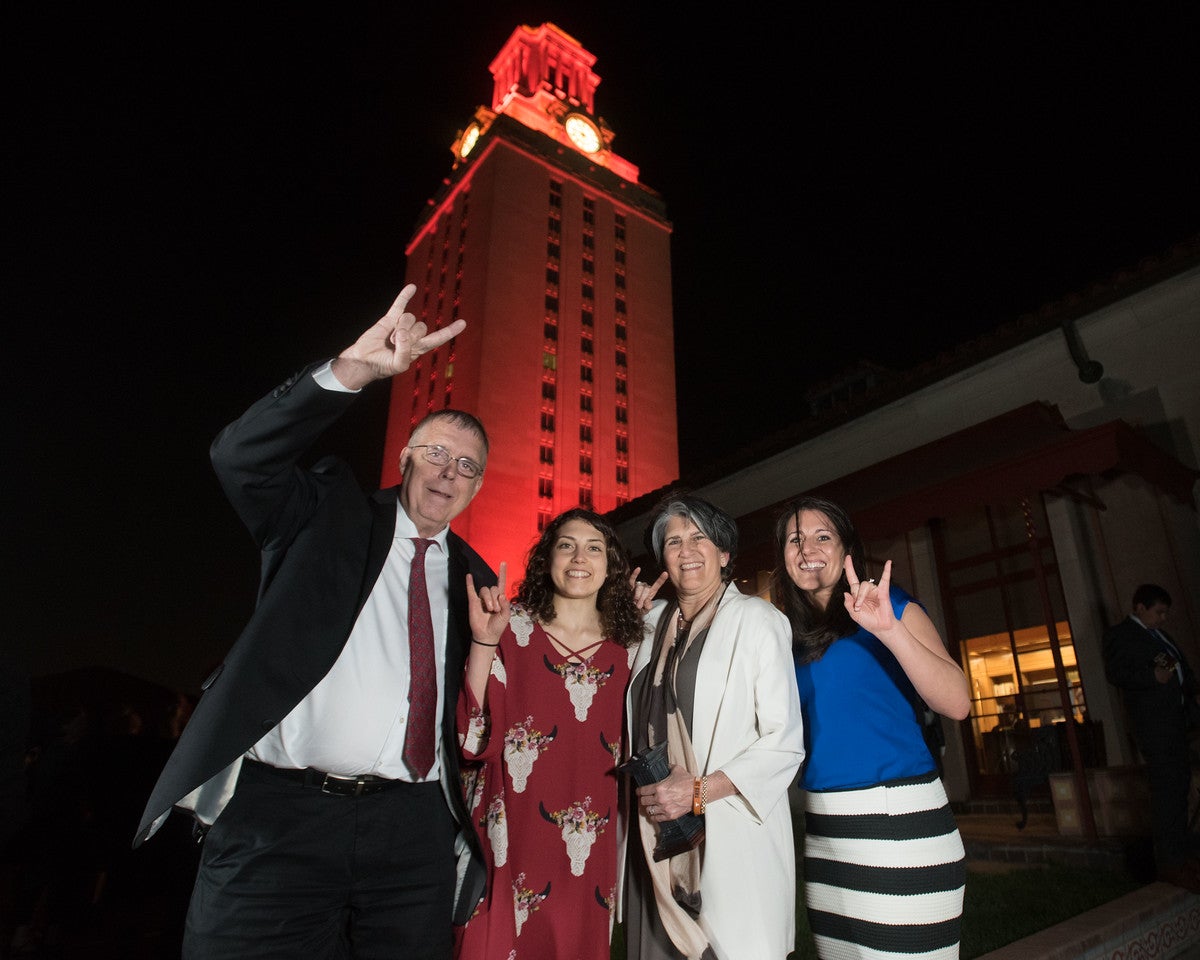
That’s one of the most wonderful things that’s happened to me at UT. My children were both in college at the time, they flew in, and we had our picture taken by the Tower.
I’ve always been service oriented. I think my 12 years as University Faculty Ombuds helped with that recognition. I had done a lot of training for Housing and Food Services. I did a training for the University’s human resources. Whatever I was asked to do that I could do, I tried to do.
So, service has been important throughout your career?
When I was a young professor, I was nominated to be on the grievance committee. Not many people wanted to be on the committee, but I thought, With my counseling skills, I’ll do well.
Then I was nominated to be the ombuds. When I was ombuds, I got to know the prior Vice President for Research Dan Jaffe, who considered me for RIO. Everywhere I’ve gotten was because of service. You need to protect your time and be careful about what you say yes
to—but have a mindset of service. UT is a great institution and we all serve.
Your career at COE began in 1986. In your time working for the college, what significant changes have you seen?
I’ve seen changes in the emphasis on faculty grant support and the number of faculty who bring in grants. The grant office is superb—it helped me get two NIH grants. Now that I’m in the Office of the Vice President for Research, I have a broader view of the different UT grant offices. The College of Education grant office is very well regarded on campus.
I’ve also seen increased funding that has enabled more student scholarships and resources for faculty research interests and other projects. As an example, last year I had the opportunity to speak with the college’s Advisory Council about my research. That conversation showed me how many COE graduates and other supporters believe in our mission and put real resources behind it with their time and financial support. And of course, my own daughter Megan (Steinhardt) Hunt ’16 benefited from the kindness of generous donors during her graduate training in the Department of Educational Psychology, and so, I’m grateful both as a faculty member and as a mom. I know COE staff are to thank for much of this work, often doing their work quietly in the background.
But what’s stayed the same at COE? Excellent teaching.