As anyone who’s parented or taught a middle or high school student can attest, motivating young people is challenging.
But one approach that doesn’t work? Delivering messages to teens that convey a lack of respect.
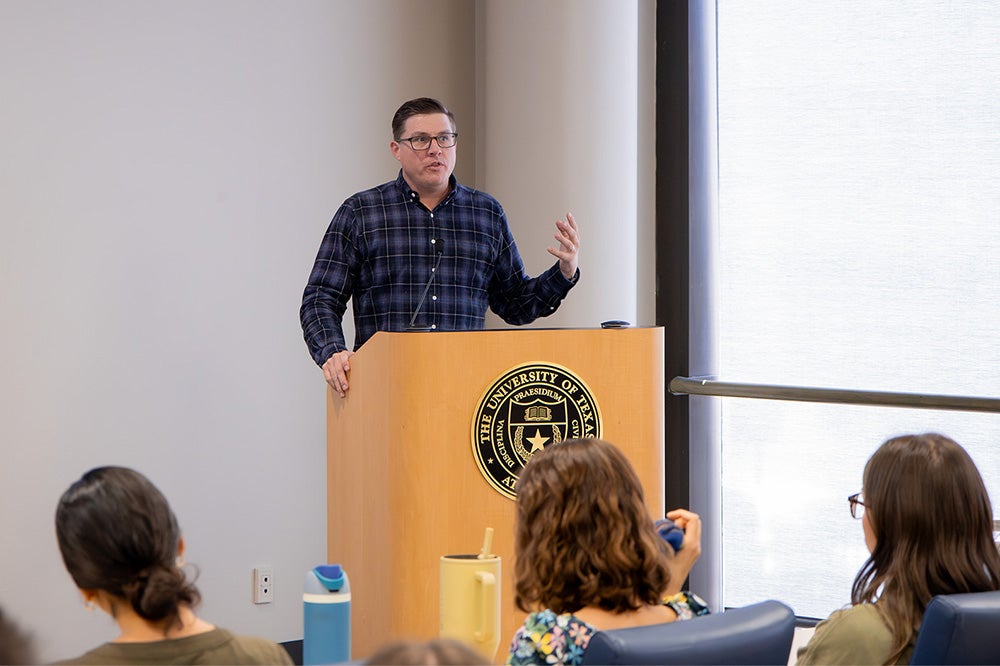
In an Oct. 22 talk at the College of Education titled “Teacher Engagement Practices and Academic Performance,” David Yeager offered research-based strategies for encouraging teens to tackle challenges, learn and grow. Yeager, a professor of psychology at The University of Texas at Austin, studies short but powerful interventions that influence adolescent behaviors and authored 2024’s “10 to 25: The Science of Motivating Young People.” His talk was the first in COE’s new Research in Education and Public Policy seminar series supported by the Gordon Lippitt Centennial Lectureship Fund.
It’s hard to influence young people,
Yeager said during his presentation. However, mentors can have a hugely positive effect on teens, as Yeager encouraged the audience to recall examples of such input from their own past. That conversation set us up to take a risk or join an activity or persist,
he said. That really paid off over time.
Young people are not impossible to change, but rather they have a different set of motivational priorities that we often don’t tap into,
he said. Because we don’t tap into them correctly, it feels like they can’t change when in fact, we’re doing it wrong.
To do it right, Yeager encourages teachers to convey an attitude of respect coupled with a growth mindset, the belief that intelligence and abilities can be improved through learning and effort.
The opposite approach—conveying a fixed mindset that traits cannot change—may harm teens. A teacher who tells a struggling algebra student, Maybe you’re not a math person
or Being a top math student requires a special talent that can’t be taught
suggests the student shouldn’t even try.
When a student asks a question in class, the teacher who responds that the teenager must not be smart enough or wasn’t paying attention to the teacher’s earlier explanation shuts down further student inquiry. That kid’s never going to ask another question,
Yeager said.
The growth mindset offers an alternative. Teachers, for example, may tell students their grade at the start of a semester doesn’t determine their grade at the end, or that asking their question aloud in class helps everyone, since other students probably wondered the same thing.
Still, for Yeager, a growth mindset is just the starting point for teachers.
Through speaking with and studying teachers, we realized that we want their growth mindset, but we also want more than that,
Yeager said. What he and his colleagues are seeking can be described as a “mentor mindset.” That’s “a mindset about kids that allows you to create the conditions for growth,” he said.
What you’re saying is, ‘I’m mentoring you along the path from what you used to know to what you can now do.’ That feels respectful because then adolescents feel challenged, taken seriously and supported,
Yeager said. It’s like, ‘I’m in your corner. I believe in you more than maybe anyone’s believed in you before.’
The next seminar series talk, Neuroimaging Investigations Into Academic and Controlled Processing in English Learners
by UT Psychology Professor Jessica Church-Lang, takes place on Nov. 19.