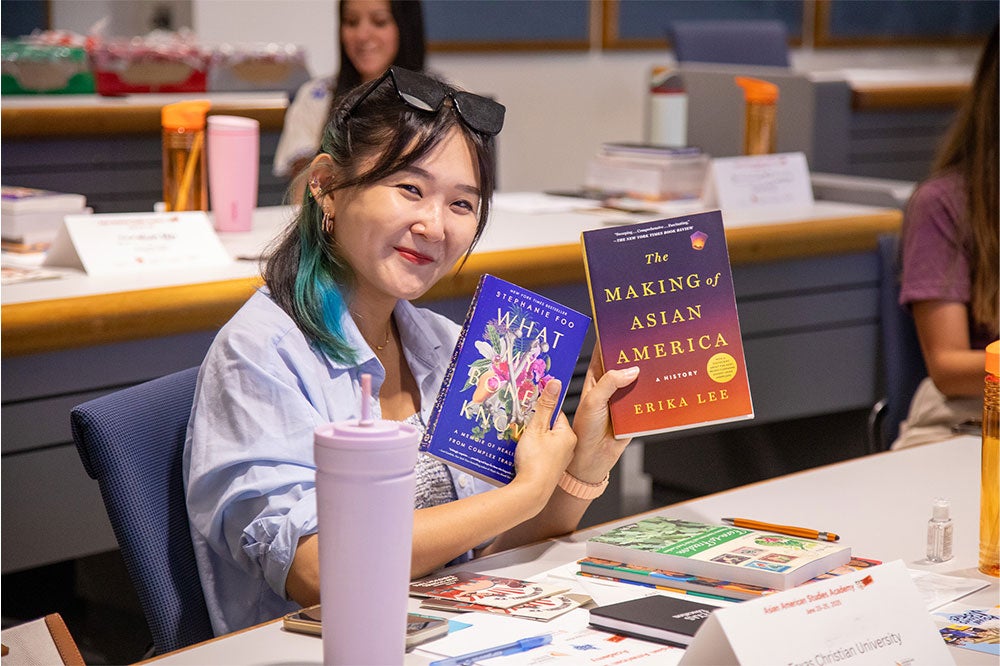
When the State Board of Education decided to revisit Texas social studies curriculum three years ago, a group led by Asian Texans for Justice saw an opportunity: create an Asian American studies course on the history and culture of the state’s fastest growing demographic.
We wanted to have more education on Asian American history because underrepresented communities often face misinformation and negative narratives within school systems,
said Mohit Mehta (Ph.D. ‘24), a founding member of the Asian American Studies Academy and assistant director for the Center for Asian American Studies at UT’s College of Liberal Arts.
Facing pushback, the issue was tabled by state educational leaders until 2025, along with other revisions to the social studies curriculum. Instead of giving up, the group took this time to prepare.
Through a partnership with the College of Education, the group formed the Asian American Studies Academy, a professional development program for educators interested in teaching Asian American history and culture.
Following a successful run last summer, the Asian American Studies Academy returned this year with new ideas such as subject-specific breakout groups and plans to expand with a series of free online seminars that teachers, families and community members can attend throughout the school year.
The Asian American community is typically ignored because there is this idea that they are doing well in school, a model minority and hard working,
Mehta said. Our goal as a grassroots movement is to invite teachers from across Texas to learn more, dispel some of those myths and complexify the narrative of Asian American identity, history and culture.
Assistant professor Cathery Yeh helped organize this year’s event alongside Mehta, Curriculum & Instruction doctoral candidate William Bae and James Lemuel (B.A. ‘23), a math teacher at Leander ISD. Yeh said the goal is to give teachers the resources to pilot a class, better relate to students’ histories and stimulate interdisciplinary education by integrating history with other subjects. For Asian American Studies to become an official elective in Texas, it must first be piloted for two years and receive approval from the State Board of Education.
To make a course happen, there needs to be some groundwork,
Yeh said. We know that to teach Asian American Studies, you need to learn histories you have not before. To reimagine education, we need to all work together.
While the first cohort focused on secondary social studies teachers, the Academy expanded this year to welcome educators across grade levels and subject areas — including special education, music, and math.
If we want to change something, we cannot do it alone,
Yeh said. If the English teacher wants a change, the math teacher should also learn about the issue– not only can they support interdisciplinary work, but they also to advocate for one another.
The academy’s content focuses on Texas-based Asian American stories to further drive the connection with U.S. and state history, building community and show teachers how integrating stories into their lessons can have a profound impact on their students.
This year’s presenters included documentarians, historians, archival experts and experienced educators. The sessions also included time for teachers to meet in subject-specific discussion groups and plan how they could integrate their new knowledge into their classrooms.
Regardless of the subject you teach, learning about our students and communities makes us better teachers,
Yeh said. For example, when we explore the United Farm Workers movement led by César Chávez, Dolores Huerta, and Larry Itliong, linear equations can be used to model income growth or disparities over time or between groups. We can teach math with context and primary sources.
Starting this fall, virtual sessions hosted every two months and featuring an array of guest speakers will forward the mission of connecting educators from across the state to tap into each other’s expertise and continuing to learn together.
Angela Buentello, a history teacher in Round Rock, initially applied to the academy to learn more about her Chinese heritage and history. She only expected to learn how Asian American peoples arrived in the U.S. Instead, she left with a humanized history that shone a light on the challenges of staying and belonging in this country.
For Buentello, the only time she recalls hearing about Asian Americans in her own education was in relation to the California Gold Rush and the Transcontinental Railroad.
Now, she returned to the academy excited for new learning opportunities that combine library research with local history to share with her students and add to her personal research on her family history.
I don’t want my students to go as long as I did to start looking into family history,
Buentello said. I have a lot more buy-in from my students now. Not that they weren’t invested in the class previously, but it opened a lot of great questions and that is what you want in a class — curiosity.
Meanwhile, first-time participant Cody Edwards, an English Language Arts specialist at Leander ISD, echoed the importance of representation.
We have a fast-growing population of Asian American students in Leander, and it’s not okay that our students don’t see themselves in the literature we teach,
he said. The Academy helped me identify gaps — both in our curriculum and my own understanding.
Edwards notes it is important to the district to maintain a culturally sensitive approach that is respectful to all students, and he looks forward to tapping into the readily available resources that he learned about so families feel more welcome in the district.
When you see yourself in literature, it can be affirming,
Edwards said. It can be a way for you to connect to a bigger world, and it builds empathy.
For Emy Chen, a recent graduate from McCallum High School, it was in 8th grade that she realized her teachers were not doing much to recognize Asian American and Pacific Islander Heritage Month. So, she took it upon herself to create information slides that included notable historical contributions and figures from her community, from astronauts to fashion designers, and sent them to her school and other district officials in Austin and beyond.
The soon-to-be freshman at Swarthmore College said she was invited last year to speak to teachers about the importance of implementing Asian American studies in K-12 classrooms and ideas for how to do so. This year, she is back helping with the academy’s social media promotion.
As a student, Asian American Studies have been largely absent or invisible in my education, with a mention maybe only regarding the Gold Rush,
Chen said. Missing identity is important because we form ideas about how we think of the world in K-12 education, and if you don’t see Asians as being American it can create conflict and make it confusing to identify as American. It encourages stereotypes including being forever foreigners and immigrants.