How can we keep teachers in the classroom? A proven mentorship program from the College of Education has come up with some answers.
Research from The University of Texas at Austin and Texas Tech University found that over half of newly hired teachers in Texas lack certification and prior classroom experience. They’re also leaving the classroom sooner, disrupting academic consistency and undermining educational quality for students and schools alike. It can cost a school district up to $20,000 to replace a new teacher.
In order to address the complex issues of teacher attrition and retention, the College of Education launched Texas Education THRIVE – a comprehensive statewide initiative and intensive mentorship program specially designed to retain teachers and strengthen the profession. The program is housed inside the Center for Research to Community Impact (CRCI), formerly known as TexCEP, an organized research center at the college dedicated to shaping policy while sharing its findings with stakeholders.
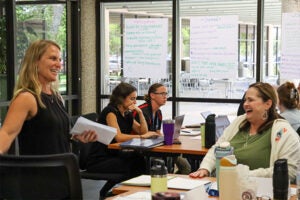
This collaborative program is designed to be self-sustaining and mutually beneficial. While early-career teachers (ECTs) gain the tools and confidence needed to succeed in the classroom, veteran teachers in turn can explore leadership roles and career advancement through their mentorship work. Each school district has unique and specific needs related to teacher support and retention. At its core, THRIVE is a responsive model that works directly with district and school leadership to ensure that those needs are being met.
The mentorship program provides targeted support to ECTs, helping to ensure that students across Texas have broader access to high-quality and consistent instruction. Through partnerships with school districts, the program pairs early-career teachers – typically in their first three years – with experienced educators who serve as trained mentors. These mid-career mentors receive specialized training through THRIVE’s Mentor Academy to guide, counsel and coach new teachers more effectively.
According to numbers from THRIVE and the Texas Education Agency, in its first two years of implementation, 90% of beginning teachers in the program were retained in education; 95% of participants showed continuous growth on their professional appraisal; and 90% of eligible participants chose to return to the program for a second year.

The THRIVE initiative, piloted under the name START, originated in the Austin Independent School District (AISD) following the pandemic and expanded into Del Valle ISD in 2024.
During the upcoming 2025-2026 school year, THRIVE will expand into six new school districts across Texas including Manor ISD, Tyler ISD, Rogers ISD, Los Fresnos ISD, Edgewood ISD and Taylor ISD.
Two of these districts, Manor ISD and Rogers ISD, are partnering with THRIVE through the Texas Education Agency Mentor Program Allotment, which provides state funds to school districts for research-based teacher mentoring programs to help boost retention and effectiveness. This summer, THRIVE hosted five new Mentor Academies across Texas, bringing together teacher-mentors for two days of hands-on learning and mentoring strategies. THRIVE coaches will continue to support mentors as they integrate these strategies into the classroom.
In total this year, THRIVE will be implemented across 113 campuses with 1,300 educators serving a student population of 65,000.
Mandy Phillips, an early-career art teacher at Del Valle Opportunity Center in Del Valle ISD, spent her summer interning with THRIVE and served on its District Advisory Committee to represent the perspective of ECTs.
My involvement with THRIVE stems from my own experiences navigating the common challenges that many first-year teachers face,
Phillips said. Mentors serve as our primary support system, making it essential to strengthen the relationship between mentors and ECTs. By doing so, we can facilitate a successful transition into teaching and encourage ECTs like myself to remain in the profession long term.
This school year, Taylor ISD, located in Williamson County just outside of Austin, is one of the newest districts to implement the THRIVE program. Twenty-three teachers, each with their own mentor, participated in the program.
According to Abby Turner, director of teaching and learning for Taylor ISD, the district currently has a relatively low teacher turnover. However, with rapid growth across Central Texas and the arrival of major tech companies like Samsung, Turner anticipates significant expansion in the school district in the coming years.
Participating in THRIVE is helping us shift from a people-dependent model of support to a sustainable, systems-based approach,
Turner said. By training mentors to effectively support new teachers, we’re building internal capacity that will position us to meet the demands of future growth. This not only strengthens support for our new teachers but also elevates the overall instructional culture across our district.
In order to expand and advance the program, THRIVE has partnered with three UT System Colleges of Education: UT Tyler in East Texas, UT San Antonio and UT Rio Grande Valley. Each college will help co-facilitate regional implementations of the THRIVE model in Tyler ISD, Edgewood ISD and Los Fresnos ISD, respectively.
Last year, Tyler ISD welcomed over 80 new teachers and anticipates a similar number for the 2025-2026 school year. The district expects to have 160 first- or second-year teachers, although this number could increase.
Staci Zolkoski, director of the School of Education at UT Tyler and associate professor of special education, plans to work closely with principals, campus leaders and mentors to extend their roles beyond the first few years of teaching, describing the THRIVE model as a multi-tiered system of support designed to enhance the collective efficacy of educators across Tyler ISD.
New teachers struggle with understanding the school culture, managing a class and supporting students in engaging lessons,
Zolkoski said. THRIVE provides specific materials mentors can use to best support their mentees. The new teacher feels successful, and students feel that success, too.
Phillips, the early-career art teacher, credits her mentorship with having a profound impact on her classroom dynamics and the way she connects with her students.
I feel incredibly fortunate to have a mentor with whom I have developed a strong, supportive relationship over the past two years,
she said. This balance fosters a positive, engaging atmosphere that I aim to replicate with my students, creating a space where learning feels both meaningful and enjoyable.
In Abby Turner’s experience, the early-career teachers she meets are passionate and deeply committed to the position, although some come in through alternative certification pathways.
These teachers face a steep learning curve,
Turner said. Beyond instruction, they must quickly learn to juggle a wide range of responsibilities, including lesson planning, student behavior, communication with families and compliance tasks. When we invest in their growth and effectiveness, we not only strengthen the profession but also ensure better outcomes for our students.