
Each day, as students, faculty, staff and visitors make their way through the busy halls of the Sánchez Building, they may not realize that directly across from the Office of the Dean, an authentic experience awaits. In fact, the very building they’re walking through bears his name — a tribute established 30 years ago.
The thought-provoking exhibit, I Am the Man You Think I Am, honors the legacy of Dr. George I. Sánchez, a champion of civil rights, a transformational leader and scholar, and a distinguished alumnus of the Educational Psychology program at The University of Texas at Austin.
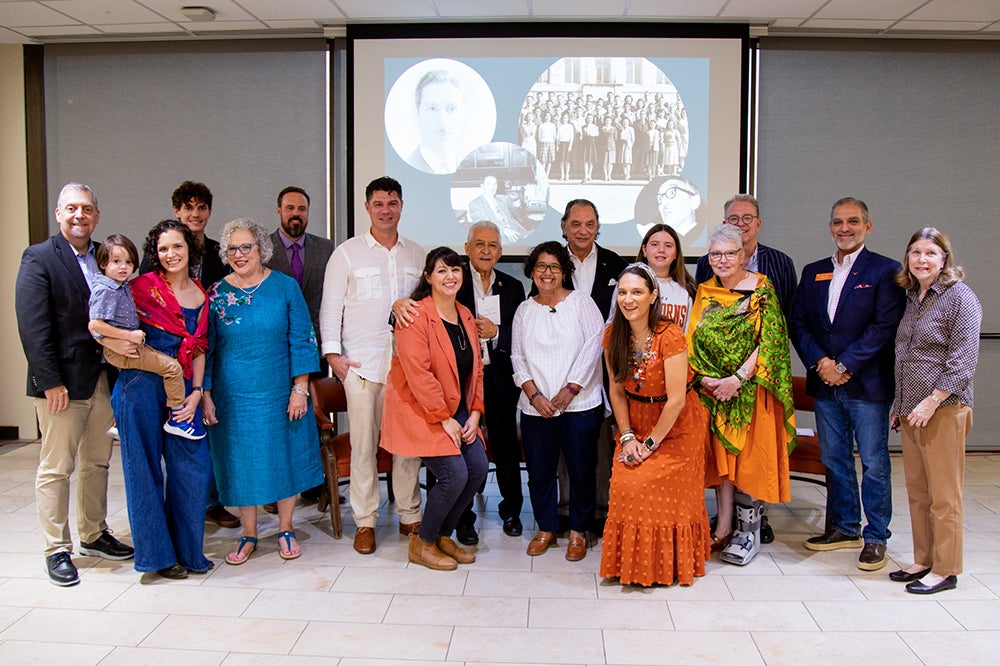
A native of New Mexico, Sánchez attended UT Austin in 1931, earning a master’s degree in science with concentrations in educational psychology and Spanish. He became the first professor of Latin American Studies at the College of Education and served as the chair of the Department of History and Philosophy.
Sánchez’s remarkable life is laid out in original documents, photos and rich archival materials provided by the Nettie Lee Benson Latin American Collection and the Briscoe Center for American History, offering an intimate glimpse into his profound intellect and advocacy.
During an October event celebrating Dr. Sánchez’s extraordinary life, Dean Charles Martinez reflected that it was Dr. Sánchez’s enduring legacy that inspired him to join the College of Education.
This display is a true testament to his extraordinary contributions to education and civil rights and serves as an important reminder of just how relevant his work remains today — from his pivotal role in the desegregation of Texas schools to his lifelong dedication to bilingual education,
Martinez said.
The Sánchez Exhibit and Uvalde Panels
The addition of the new Uvalde panels, curated by Drs. Monica Muñoz Martinez and Annette M. Rodríguez, researchers from the UT History Department, captures the racial and linguistic segregation which shaped generations of Mexican American students, both before and after the landmark Brown v. Board of Education ruling.
They also feature archival materials from the Benson Latin American Collection, illustrating how segregation was not only legal but spatially engineered through school zoning, infrastructure and everyday life. The addition of the Sanborn Fire Insurance maps details how segregation was woven into the fabric of Uvalde, impacting its neighborhood layouts and school district lines.
I Am the Man You Think I Am
In a panel discussion at the event, former State Senator Gonzalo Barrientos, Carlos Blanton, professor of Texas history, and Angela Valenzuela, professor of Educational Leadership and Policy, shared their perspectives on Sánchez’s enduring influence.
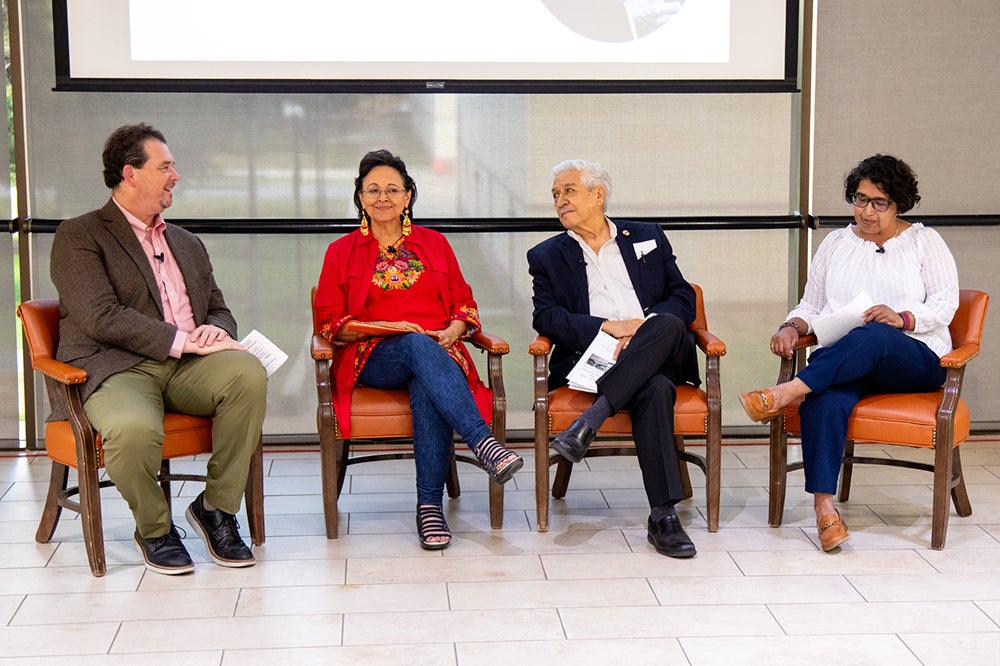
What inspired me about his life was that bridge between the scholar and the activist,
Valenzuela said. It’s a very fluid relationship — the breadth, the depth and the intellect. The way he engaged life on a regular basis is a testament to the real virtue that comes from being in the field and caring for people who have much less than you.
Blanton, the author of George I. Sánchez: The Long Fight for Mexican American Integration,
was surprised to learn of Sánchez’s humor in his research.
When you live with injustice in your head, it can really weigh on you,
he said. Sánchez kept fighting with a sense of humor. That’s the model of someone who can fight but not lose their humanity along the way.
The Inspiration of George I. Sánchez
Sen. Barrientos discussed growing up in Bastrop, Texas in the 1940s, where he and his family worked in the cotton fields until his parents, who had no formal education, enrolled him and his sister in the local Mexican school. Around that time, the 1948 lawsuit Bastrop vs. Delgado ruling declared the segregation of Mexican American students unconstitutional.
Barrientos shared that he attended the exhibit to personally thank the Sánchez family and to reflect on the images of those — especially Dr. Sánchez — who helped end segregation and unite the Mexican American community.
The work of Dr. Sánchez is a solemn reminder that equity demands both policy and persistence, pairing legal change with ongoing activism and community leadership,
Dean Martinez said. His work continues to inspire educators and policymakers working to close opportunity gaps and ensure that all students, regardless of language or background, can thrive.