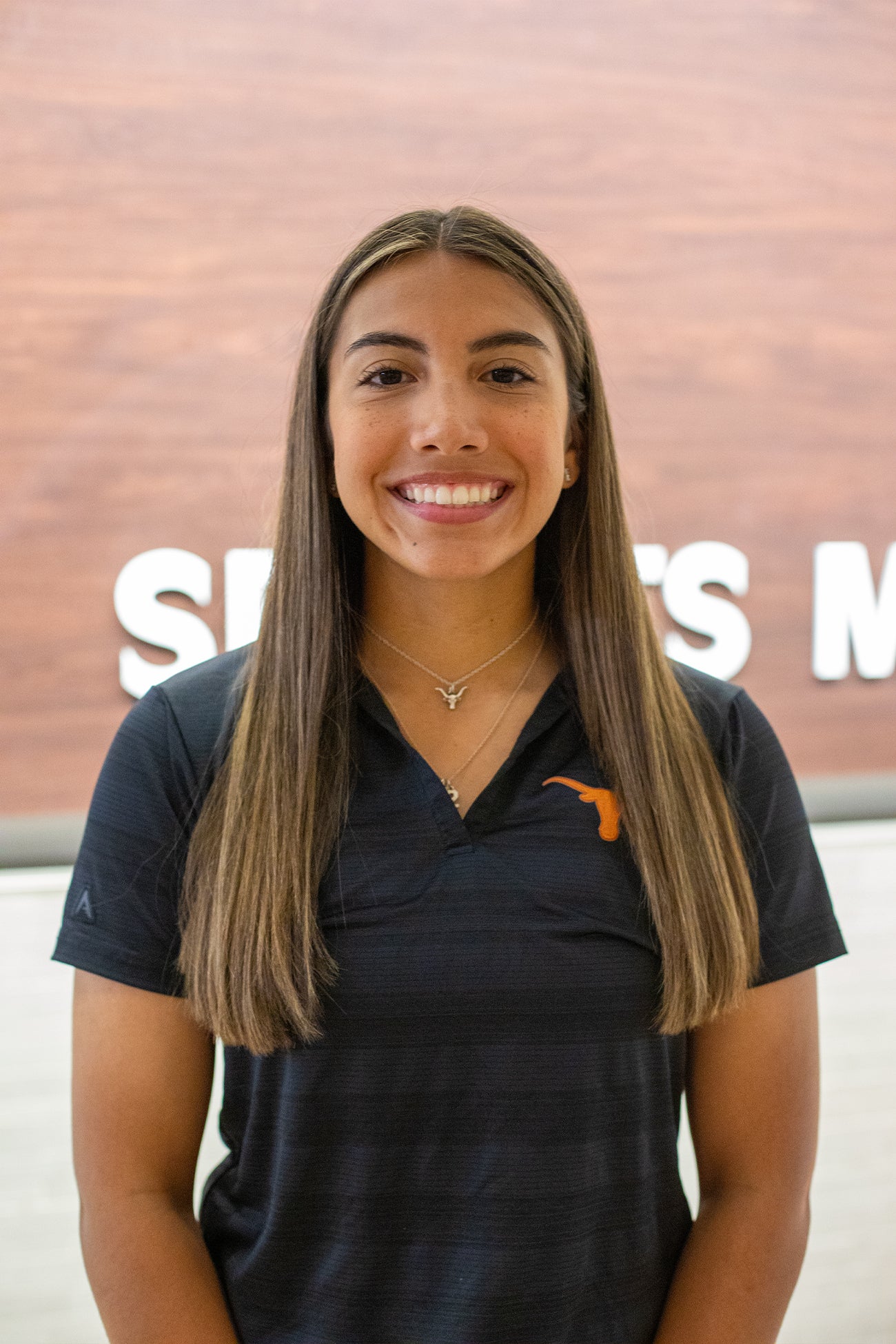
Caitlin Gonzales was so sure she wanted to attend The University of Texas at Austin that it was the only school to which she applied her senior year of high school. But it was her lifelong love of sports that truly helped her find her place on the Forty Acres.
Growing up in a San Antonio household divided by the centuries-old rivalry between UT Austin and Texas A&M University, Gonzales was initially torn between her mother’s Longhorn legacy and her father’s Aggie roots. In the end, UT Austin’s academic prestige, proximity to home and the professional advantage that a UT education had given her mother as a nurse inspired Gonzales to follow in her footsteps.
Deep down, I always wanted to go to UT,
Gonzales said.
Now, Gonzales, a senior athletic training and exercise science student, walks the campus with pride, from the classroom to the football field, as she lives her dream of combining sports with her passion for helping others. As one of dozens of students who participates in the College of Education’s Athletic Training program, she receives hands-on learning experiences as part of her clinical training, and works alongside UT athletes.
From Playing to Training
The opportunity to support Texas athletes comes naturally to Gonzales, who played volleyball and track in high school. She soon set her sights on athletic training after experiencing the impact of the athletic trainers on her and her teammates.
I always knew I didn’t want a regular 9 a.m.- 5 p.m. desk job,
Gonzales said. After spending a lot of time with my team’s athletic trainer following my senior season, I was ready to pursue this path.
The program serves anywhere between 500 and 600 students. The program’s athletic trainers build thoughtful relationships with many athletes and one became a trustworthy mentor.
My senior year, I was coming off of an ankle injury and every game I had a routine to go and get taped,
Gonzales said. He made sure to stay until it was time to tape me before my games, and I could always count on him being there.
Now, her time at UT providing this service for others has been invaluable. In addition to the classroom, she said she is grateful for the chance to have worked on the sidelines with Texas Football for three seasons.
Being here and having these experiences has really set me up for life and has allowed me to build connections that I will forever cherish,
Gonzales said. It has taught me a different kind of resilience and to challenge myself every day.
Resilience Training
Part of that resilience and discipline comes from the scheduling and time management abilities required of athletic training students in order to meet the demands of their clinical work. On an average weekday, students start their day around 5:45 a.m. to help set up water coolers and ice around the field and prepare water bottles.
When practice begins, assignments vary with experience as students become increasingly trusted to support athletes with simple treatments like hot packs. Eventually, some students are allowed to conduct preliminary evaluations and suggest exercise plans for rehabilitation.
Before away football games, athletic training students assigned to the team help pack trunks which can include braces, slings, padding, medication, first aid, topical lotions, fans, ice and hot packs, supplies and game clothes for the team’s athletic trainers and medical staff, as well as other frequently needed sideline items.
If the team is traveling, assigned students travel Thursday evening or Friday morning to set up the necessary supplies ahead of the weekend match up. If the game is hosted by UT Austin, student trainers arrive several hours ahead of kick-off to set up and divide duties, which include providing support for visiting referees.
My biggest piece of advice would be that it all starts with grinding through the monotonous things,
Gonzales said. You will probably set up practice 20 times before you ever touch a patient.
Throughout a typical game day, athletic training students’ responsibilities vary but include a rotation of providing water to players during timeouts, assisting players on the sideline as players substitute in and out, checking on players along the bench, refilling water bottles and coolers, giving water to referees, and standing by near carts at each end zone in case someone is injured and needs assistance.
All in all, Gonzales said she estimates putting in about 20 to 25 hours of clinical work with the football team per week this year, with other years ranging from 30 to 35 hours.
Team Player
In retrospect, Gonzales said every minute has been worthwhile. Last summer, her experience culminated in an internship with the Houston Texans NFL team, which she describes as the highlight of her time as a Longhorn. She was excited to translate her skills from working with Texas Football to a different setting.
Being at a professional level is not something a lot of people get to say they have been able to do,
Gonzales said.
During her time with Texas Football and the Houston Texans, Gonzales said the days are particularly grueling as athletes partake in camps that prepare them for the season.
The hours are long and everyone gets delirious at a certain point, but because everyone is going through the same things, the struggle is not as bad,
Gonzales said.
As she completes her final year of her undergraduate degree, Gonzales said she is already looking to the future with hopes of attending graduate school for both physical therapy and athletic training certifications. Someday, she hopes to work with a professional football or volleyball team, and eventually open her own practice.
I want to give people a different outlook on injury and the rehabilitation process,
Gonzales said. When you get injured, sometimes it can feel like it is the end of the world and it takes away a part of you that you thought you would never lose. I hope to help people get better but also be a support system.
One of her favorite memories includes supporting a player who sustained a season-ending injury early in the football schedule and accompanying him through the rehabilitation process, from injury to surgery and back out on the field.
Knowing that I was able to be a small part in that process was a full-circle moment,
Gonzales said.
Challenging Herself
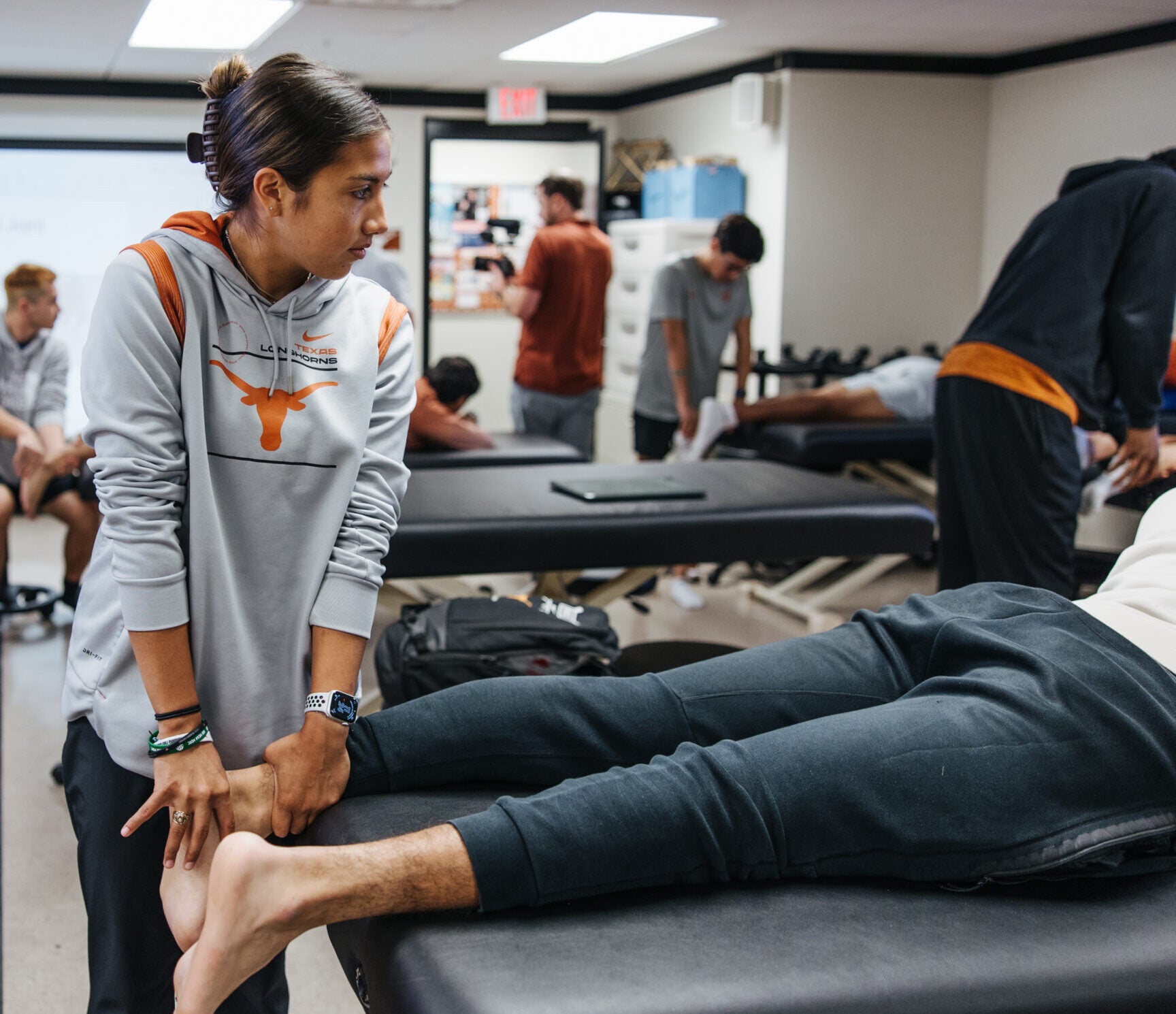
It was a combination of her experiences in the athletic training program and her time with the Houston Texans that truly affirmed Gonzales’s career aspirations to work in a professional or collegiate sport setting. Most importantly, she is grateful for the support from COE faculty who lead the program and provide these opportunities.
COE no longer offers an accredited undergraduate athletic training program; it is only offered at the master’s degree level. However, the bachelor’s degree in athletic training still offers most of the same courses that the accredited program had for over 20 years, making it among the only of its kind and caliber nationwide.
According to Brian Farr, director of the athletic training program, UT Austin students have the unique opportunity to work as sports medicine aides with Texas Athletics, where they work alongside faculty and clinical staff, as well as world-class athletes and renowned facilities.
We want students to think and act like future healthcare professionals, and we expect them to develop a solid work ethic both in the didactic and clinical settings,
Farr said. We want them to know they are prepared and ready for graduate and professional schools in athletic training, physical therapy, physician assistant studies, chiropractic, and allopathic and osteopathic medicine and become someone they would send their family to see.
Kelvin Phan, clinical assistant professor in the Department of Kinesiology and Health Education, said his best advice for aspiring students is to approach athletic training with curiosity, commitment and a growth mindset.
Ask questions, explore ideas for the sake of learning and not to fulfill an assignment and show up consistently and with dedication, even when the work is challenging,
Phan said. Be open to becoming a better version of yourself every day and adapt to change.
Gonzales said she advises future students to trust the process and embrace the difficulty of clinical assignments and coursework.
If you find yourself struggling, just know that the struggle won’t last forever,
Gonzales said. The short-term sacrifices like losing sleep or feeling like it’s the end of the world when you don’t do well on a test will be outweighed by the long-term benefits of putting in the hard work. Be resilient and know that everything will pay off eventually.