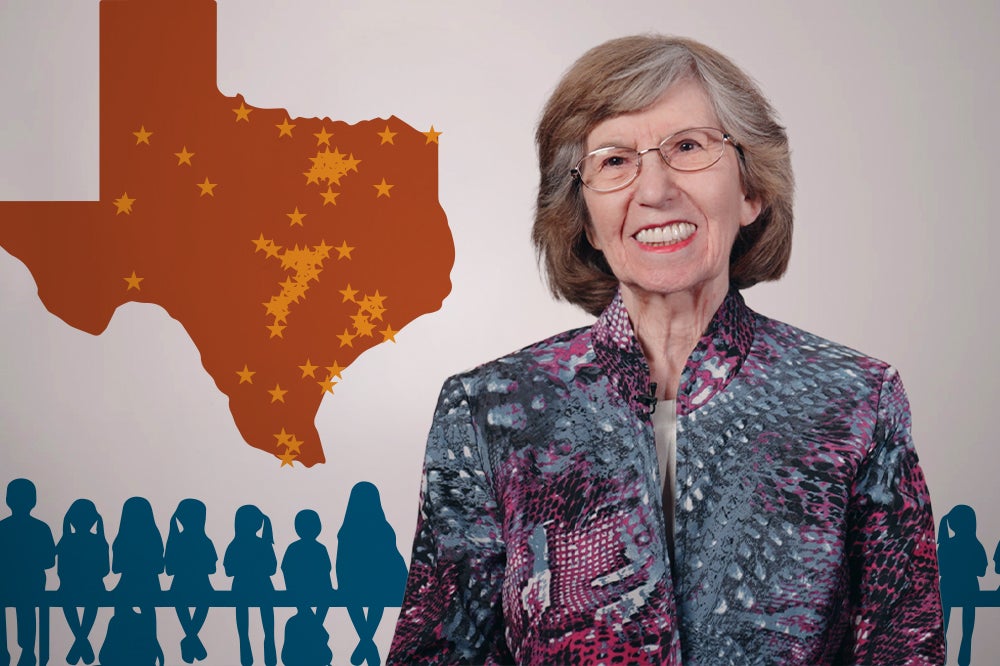
Susan Sclafani, Ph.D. ’87, has a passion for education that runs deep. After more than four decades as a leader in the field, she says she has loved every job she ever had.
She came to The University of Texas at Austin from the Houston Independent School District back in 1985, specifically to study under Nolan Estes, who served as director of the Cooperative Superintendency Program (CSP) for more than 25 years.
Nolan Estes was a world thinker,
Sclafani said. He was a global thinker. And that meant that he saw beyond the immediate to the ramifications in an instant.
After graduating from the program, Sclafani went on to serve as Chief of Staff for Educational Services at Houston ISD, and later as Assistant Secretary for Vocational and Adult Education at the U.S. Department of Education under the George H.W. Bush administration.
Sclafani credits the CSP for providing the strong foundation and professional network that helped bolster her career trajectory and success. She established CSP’s first endowment as a way of paying it forward and encourages other alumni to do the same.
Her passion for the program was inspired not only by Estes, but also by L.D. Haskew, the founder of the program.
L.D. Haskew’s vision of every district in the state being run by a graduate of the Cooperative Superintendency Program was not for his ego,
she said. It was because he understood that the student population in this state is so diverse, from the poorest of the poor to the richest of the rich. And he knew that education would be the equalizer.
We often hear from alumni of the Cooperative Superintendency Program that the program is like no other in the way that it prepares you for leadership in public school education. What do you think makes the program so special and unique?
The beauty of the Cooperative Superintendency Program was that it was a cohort program. It brought together a group of people for two years to connect their past experiences with current experiences and project what that might enable them to do in the future. All of us gained from the experiences of the other, from the small districts to the largest districts, and we learned a lot from that.
For me, the best part of the program was that we were all able to live in Austin because we had internships at the Texas Education Agency. They didn’t pay a lot of money, but they paid enough money that we could live in Austin, and that meant that we were there 50 weeks a year. We were in classes together all the time.
The opportunity to intern with the Texas Education Agency (TEA) was special for a number of reasons. It gave us the chance to get to know the people at the agency from top to bottom, from the commissioner who was readily available to the CSP cohort, to the people to whom we were assigned, to the accreditation group. All of us went out on accreditation visits, which showed us a whole different side of school administration.
My time at CSP absolutely broadened my vision because I was spending every day with people with very different experiences who came from smaller districts who had grown up in a variety of places in the state of Texas. They were learning as I was and willing to share what was hard about that, what was easy about that, what made it important for our future.
For me, this was particularly important because I came from the Houston Independent School District. I was a city person. I had no idea that there were school districts in Texas that had only 24 students. How do you run a district with 24 students with one central office person as compared to having to do all of the work that the people in Houston had to do?
How did CSP prepare you for your future roles as chief of staff for Houston ISD and as counselor to Secretary Rod Paige at the U.S. Department of Education?
I would say that what prepared me most was getting to know people from a variety of backgrounds, from a set of districts that were very different from my own experience. That helped me as I went back to Houston because we had parts of the district that had small schools in neighborhoods that were somewhat cut off from the rest.
All of the experiences that I had there enabled me not only to move up in Houston to take on more and more important roles, but then to move with Rod Paige to the U.S. Department of Education and first be a counselor to the Secretary, where I was the interference person. It also enabled me to run a department, the Office of Career and Technical Education Department, that worked with adult education as well.
You had school districts across the country of various sizes, and yet we were making policies at the federal level that were going to apply to all of them. For me, it was a doubly important experience, not just for my work in Houston, but also for my work at the U.S. Department of Education.
You have been a strong supporter and advocate for the CSP for many years. Why have you invested your time and resources into the program and why should others do the same?
I want CSP students to come out understanding that their opportunity will give them the knowledge, skills and habits of mind necessary to be a school leader, to be a district leader, because that was the whole point. L.D. Haskew’s vision was that every district in the state would be run by someone who came through this program, because he knew that through their focus on research, through their focus on working together on projects, through their focus in their classes, that they were going to be thoughtful leaders who understood the criticality of what they did and its impact on students.
That’s why I am so committed to this, why I am so passionate about it, because I know what it did for me. I know that it enabled me to move forward in arenas that I had had no experience in prior to the program, and to be successful at all of them. Because I could harken back to the experiences that I had in the Cooperative Superintendency Program.
Education provides children opportunities to succeed, to excel, that they otherwise could not have. That leads to further development of the state of Texas, further development of our country and the world.
Join Us
Support the Cooperative Superintendency Program Legacy of Leadership Endowed Excellence Fund to help recruit the best and brightest to the Forty Acres and provide the hands-on learning that is a cornerstone of the program.