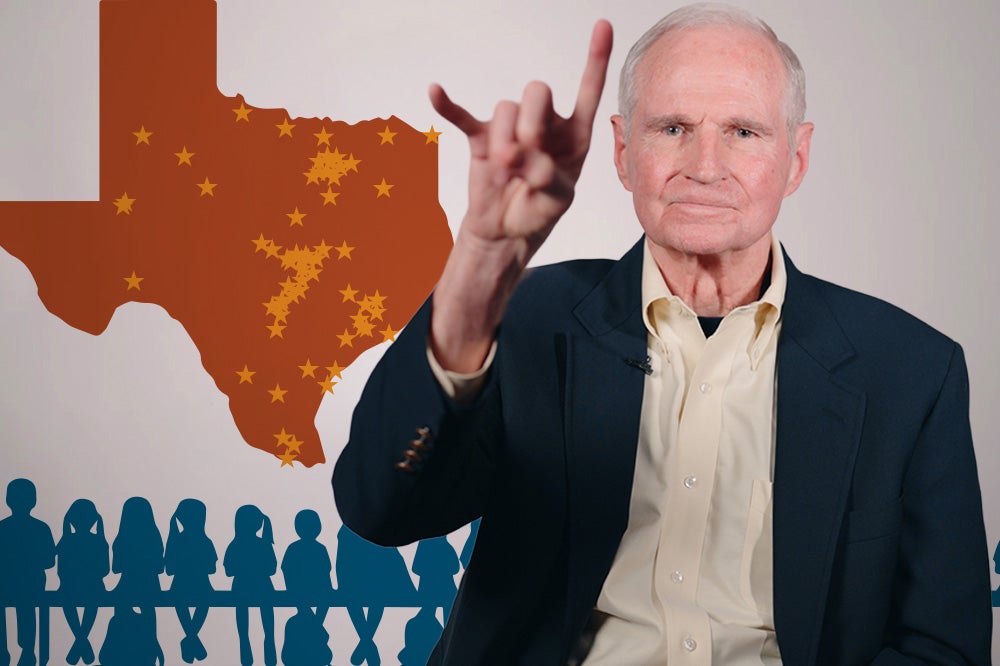
Before becoming a member of the very first cohort of the Cooperative Superintendency Program in 1975, Tom Anderson came to the Forty Acres as a freshman physical education major. When he first met CSP Founder L.D. Haskew, he recognized him immediately as a visionary leader, someone who always put his students first He even wrote (and rewrote) his dissertation for Haskew.
After graduating from CSP, Anderson spent 20 years at the Texas Education Agency (TEA), serving as deputy superintendent several times during his tenure. He went on to become superintendent at San Marcos Consolidated Independent School District before moving to an Ed-Tech company.
Looking back on the program, Anderson credits the unique partnership between the University and Texas school districts as one of its greatest strengths.
The superintendent is the leader, and leadership is the key to success in anything,
he said.
He hopes that fellow alumni will contribute to the program that they love. You support it personally and you should support it financially too,
he said.
Tell us about your experience as part of the first cohort of CSP.
I was at the Texas Education Agency as the assistant to the deputy commissioner for Programs and Personnel. I was also the director of the Teachers Professional Practices Commission. And Dr. L.D. Haskew and former Commissioner of Education Dr. Marlin Brockett established the Cooperative Superintendency Program. We were 12 students at that time, individuals from throughout the state who came to Austin to do their academic work at The University of Texas and to intern at TEA.
So I thought, this is a great opportunity. Two of us from the agency were selected at that time, me and Dr. James Hill, who went on to become the first Black vice president at UT Austin.
What do you remember about CSP Founder L.D. Haskew, and what impact did he have on you personally in your academic career success?
My first meeting with L.D. Haskew was in the fall of 1959, when I was a freshman education major. And here you had the dean of the college teaching, and it was great. We were in a great lecture hall. Students were the priority. That’s where we need to focus, on our students.
Haskew was the visionary. There were 12 Fellows in that first cohort. People around us didn’t know what to call us. They said we were either the 12 Disciples or the Dirty Dozen. They were calling us the Dirty Dozen most of the time.
What are your thoughts on the importance of the role of superintendent? What are the tools that CSP provides to succeed in that role?
The superintendent is the leader, and leadership is the key to success in anything, whether it’s football at UT or whether it’s educating children in Texas. The program has developed numerous outstanding leaders when you look and see what they’ve done or follow their careers. They have made a significant difference in the whole education process. And ultimately, students profit.
What has made CSP so special and unique?
The people make it special. I look at the leadership, especially Dr. Haskew and Dr. Nolan Estes, the first director, and the leaders that have come since then. And they were great people, great leaders and great persons to be around. I’ve known over the years a number of CSP scholars, student scholars, when I was deputy commissioner. I had a number of them as interns and got to know them quite well.
What I think is the most important part about the program is the people that have been in it, and I’m sure the people that will continue to graduate from it – future leaders.
Why should people support the program?
I think there are three or four primary reasons. First, it develops high-level, excellent educational leadership. Second, it supports positive outcomes for students, for teachers and for districts. It promotes or develops great organizational management skills. And then I think the partnership between the University and school districts is very, very special.
The foundation of the Cooperative Superintendency Program is truth in leadership. That’s an underlying theme that will continue as society and education changes in the future.
Join Us
Support the Cooperative Superintendency Program Legacy of Leadership Endowed Excellence Fund to help recruit the best and brightest to the Forty Acres and provide the hands-on learning that is a cornerstone of the program.