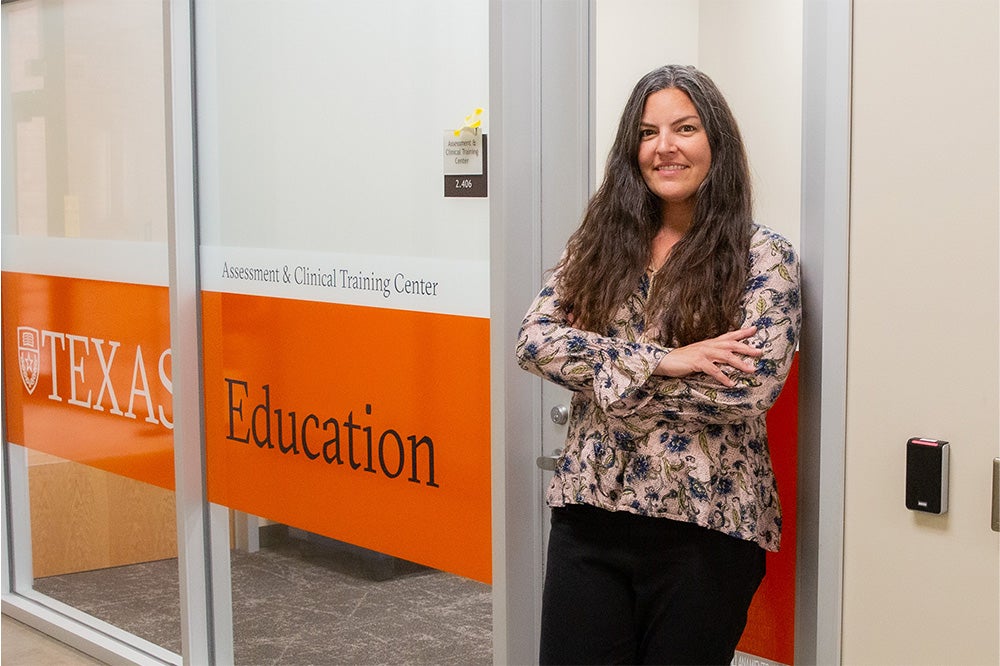
As director of clinical training for the School/Clinical Child and Counseling Psychology doctoral programs, Jane Gray has spent years watching her Ph.D. students grow as both scholars and clinicians during their six-year academic journey. Inspired by their dedication to the field, Gray sought new ways to better prepare them for their clinical practice through more hands-on experience.
Last year, she began a free mini training clinic within the existing training space in the George Sánchez Building, creating an opportunity for students to receive supervised practice in therapy with children and families from UT Elementary. Designed to provide foundational clinical experience before students begin community placements, the clinic began as an initial pilot with just one family in spring 2025 and has expanded to serve five families this semester. The children they see range in age from eight to 16.
The hope is to grow the clinic exponentially.
The student therapists, now in their second year of the School/Clinical Child Psychology doctoral program, each work with their own clients while receiving guidance and support from advanced students who serve as peer supervisors. These students are either registered in Gray’s course or volunteering their time. As a licensed psychologist, Gray provides supervision to both the student therapists and peer supervisors, ensuring that families benefit from high-quality health care and students receive comprehensive training as therapists or supervisors.
What I noticed was that our students were not as prepared as they needed to be for that jump into therapy in the community,
said Gray, an associate professor of practice in Educational Psychology. I felt like we needed to do some foundational training in intake, diagnostics, interviewing and working with a family to determine their goals so the students can learn the mechanics of being a therapist.
Student Therapists in Action
Gray also saw opportunities to expand training for the advanced students in clinical supervision, which is among the most common professional roles for psychologists, although many doctoral programs do not provide in-depth training to prepare them for this role.
UT Elementary, housed in The University of Texas at Austin charter school system, serves as a training site for UT students including future teachers, social workers and psychologists. Because families are already connected to the University, the intake process and participation in the clinic seem more accessible. Gray works with Janina Roberts, UT Elementary’s director of social programs, to raise awareness about the training clinic and coordinate family referrals.
In terms of free services for families, the clinic provides some relief for the community,” Gray said. “Austin has a lack of services for families who are unable to pay out of pocket for mental health services.
The clinic provides free services to children experiencing challenges such as low self-esteem, anxiety, adjustment difficulties, behavioral concerns and other issues. Open on Thursdays from 4 to 7 p.m., the clinic operates as part of Gray’s advanced practicum course, giving her students structured and supervised clinical experience. Most children see a student therapist for an average of eight therapy sessions.
The type of therapy we’re providing is for social emotional or behavioral concerns at a mild to moderate level in order to fit the level of our student therapists,
Gray said. Every family that we’ve seen has been an appropriate fit.
Expanding Clinic Services
Although the clinic does not yet have the resources to conduct formal assessments for learning differences such as ADHD, interest in those services has grown. Gray hopes to expand its capacity and services as it gains more experience and support.
Our community has few resources to provide comprehensive assessment for learning differences in children unless you’re willing and able to pay out of pocket,
she said.
With additional funding to sustain and grow the clinic, Gray would like to broaden operations beyond the current practicum course by offering services on additional evenings and hiring a dedicated clinic director.
Hopefully, we can make a case for growing and providing services and training for more students,” Gray said. “If we could offer additional programs where families don’t have to pay for services, it would be huge.