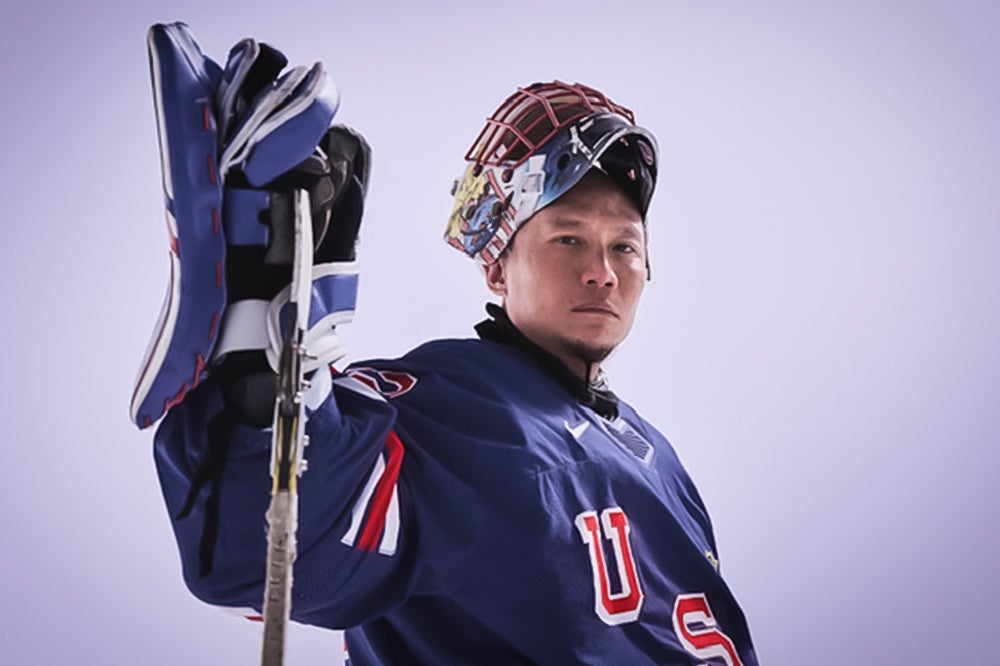
The U.S. Paralympic Sled Hockey Team recently brought home its fourth consecutive gold medal – a milestone that captures the inspiring journey of College of Education alumnus Jen Lee (B.S. ’18), a four-time Paralympic gold medalist and proud Army veteran who closed out his competitive career as goalie with a victory over Canada.
His remarkable story will take center stage this spring as he delivers the 2026 College of Education Commencement keynote address.
Lee earned his bachelor’s degree in Sport Management from the Department of Kinesiology and Health Education at the age of 28 – an unconventional path for an extraordinary individual.
Born in Taipei, Taiwan, and raised in the San Francisco Bay Area, Lee enlisted in the Army after graduating from high school in 2004, first serving as an aircraft mechanic and later as a staff sergeant in Iraq. Five years later, a motorcycle accident resulted in the loss of his left leg.
For some, that could have marked the end of their military career. Instead, after a year of rigorous physical therapy and rehabilitation in San Antonio, Lee remained on active duty. He discovered adaptive sports, including sled hockey, and was accepted into the prestigious Army World Class Athlete Program, where he trained for the Olympic and Paralympic Games. His grit and determination ultimately earned him a spot on Team USA.
Nobody ever says, when I grow up, I want to be a paralympic athlete,
Lee said, especially if you weren’t born with a disability. It helped that I grew up playing sports competitively – varsity basketball, track and field – and that sports are highly encouraged in the military.
At the age of 28, he applied to The University of Texas at Austin as a transfer student and graduated with a bachelor’s degree in 2018. During his time on the Forty Acres, he developed a deeper understanding of the challenges facing athletes with disabilities, like inclusiveness and equality, and the vital role sports play in shaping their lives.
Q&A with Jen Lee
You began your college journey at 28. What was your decision-making process in pursuing a degree alongside your athletic career? How did you navigate and balance those two paths?
Finishing college became my first priority; sled hockey was second. I initially planned to become an athletic trainer, drawing on my experience and natural comfort in sports settings. But after two semesters, I realized it wasn’t the right fit for me, and I switched to the Sports Medicine program.
Working on the medical side of sports and supporting people with disabilities is incredibly meaningful. As an older student in kinesiology, I brought a different perspective and mindset to the classroom.
I didn’t come to UT to be that guy
or to draw attention to myself as a Paralympian. But in Austin, it’s hot. I’m wearing shorts most of the time with my prosthetic. There’s a certain pressure that comes with being an amputee.
You transferred to UT in 2015 from University of the Incarnate Word in San Antonio but left after your first year, returning to graduate three years later. What was your time away like?
I felt the itch to return to the national team, which wasn’t easy after stepping away for a year. It was a battle to make my way back competing with younger contenders. When I graduated in 2018, I was also selected for the Paralympic Games in Korea. In many ways, I was pursuing parallel paths – continuing my career as a Paralympic athlete while earning my degree in sport management.
What challenges did you encounter on campus, both academically and physically, and how did you overcome them?
I got involved with the Student Veterans Association and the Disability Advocacy Student Coalition, which helped me find support and build community. Overall, I think UT has done a good job with ADA compliance and providing accommodations for students with disabilities.
That said, in some classrooms, students with disabilities were expected to sit in designated areas, often in the front. That can feel isolating at times, being set apart from everyone else.
This is where the student coalition played a key role in exploring ways to modify and adapt accommodations.
Now that you’ve retired from competition, do you see yourself working in athletics or a related field?
I’m fortunate to have access to strong networks of veterans, Team USA athletes and UT alumni. I’ve realized that I’m passionate about coaching. Even while competing, I coached summer camps during our offseason. I’m currently enrolled in online certification courses through the National Academy of Sports Medicine to become a personal coach and wellness trainer.
As a practicing Buddhist, I’m also exploring the spiritual and mental side of training and wellness. I believe I can offer a unique perspective, particularly when it comes to the mental side of performance in both fitness and competitive settings.
Whether I’m working with a new client who wants to get in shape or improve their health, win a gold medal or run a mile without stopping, it starts with understanding their goals and helping them find the best path to achieve them.