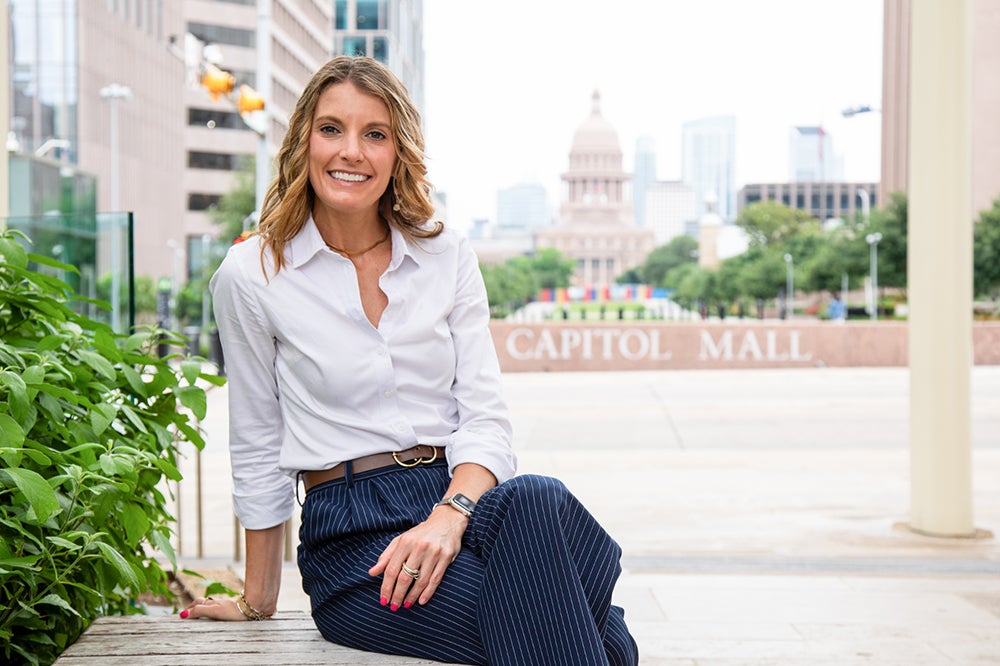
Rachel White has maintained a lifelong connection to school governance.
White earned her undergraduate degree in public policy from the University of Michigan, master’s in education policy and leadership at Ohio State University, and doctorate in education policy from Michigan State University, before working as an assistant professor at Old Dominion University in Norfolk, Virginia and the University of Tennessee, Knoxville.
White is now two years into her College of Education role as associate professor of Educational Leadership and Policy. Her scholarship focuses on issues of representation and power in K-12 public school district governance with an emphasis on superintendents.
As a public-facing scholar, White is in the field all the time.
That shapes both her research questions and teaching approach.
White founded the The Superintendent Lab, home to the only national longitudinal database of K-12 public school superintendents, which she has updated each year since 2019. In April, TSL launched a brand new superintendent labor market dashboard that provides a national overview of trends in superintendent turnover and stability; turnover by subgroup including district type, enrollment, student demographics and superintendent gender; and trends in superintendent turnover, such as the proportion resulting from retirements, resignations and firings. Tools like this provide state leaders, superintendent support organizations, and state education agencies, as well as journalists, with a pulse on what’s happening in their state, region, or the nation,
White says, and leaders in these spaces can use this data to consider the types of programming or targeted training necessary to better support all or sub-groups of superintendents.
The data collected in TSL also informs White’s own research into superintendent labor market trends.
We recently spoke with White to learn more.
Your scholarship looks at school governance. How would you describe your approach?
I typically use quantitative data to identify trends and patterns, and then I dig into the hows
and whys
with interviews, focus groups and document analyses. The qualitative component of my work often focuses on politics in the superintendency, because I’ve found that politics and school boards are two of the lead reasons for superintendent instability.
What initially prompted your interest in this topic?
When I was 1 year old, my father joined the local school board in my hometown—a tiny town called New Lothrop, Michigan. He’s still on the board almost 40 years later. So, school governance has always been a part of my life. Initially, I had no interest in pursuing this as a career. I attended a rural public school that offered just one Advanced Placement course. When I arrived at the University of Michigan, I felt incredibly unprepared. I was working two to three jobs while also studying to catch up to my peers who had more advanced coursework in high school.
When I was a junior, I was required to take a K-12 education policy class. I had no interest in studying something that I felt resentful of. After the first class, however, I was hooked. I had found a career that would allow me to potentially help others with similar backgrounds—first-generation college student, rural—have a better experience than I did.
Did any personal experiences further your passion for the subject?
While I was earning my Ph.D., I served as a policy analyst for the Michigan Association of School Administrators. Any time the state legislature introduced a new bill, it was my responsibility to analyze what that meant for all 640-plus public school districts in Michigan and then work with superintendents to communicate to the legislators. I saw the leverage superintendents had to shape state policy. Meanwhile, in my doctoral program classes, we’d talk about policy and policy implementation, but we never talked about superintendents. My educational and work experiences just weren’t connecting. Because of this, I really wanted to bring attention to the role that superintendents play in policy leadership.
Then, I served as a local school board member—and eventually vice president—in Van Wert, Ohio. My time on the board spanned the COVID-19 pandemic, and I had an intimate view into the superintendent’s important role in student educational experiences, opportunities and outcomes. I also coached cross-country and track for eight years at three different schools. This blend shaped how I think about the important role district governance and leadership plays in the experiences kids have.
That must have been valuable background for your scholarship. What are the origins of The Superintendent Lab? And nowadays, who typically accesses the lab’s data?
Initially, I created the National Longitudinal Superintendent Database in 2019, and I saw increasing public interest. So, in 2022, I established TSL for people to access infographics and data visualizations on the superintendent labor market and other research on the superintendency. TSL was a way to elevate this to a more public domain.
My interactions tend to be with state associations of superintendents, and most don’t have any data on their state’s superintendent labor market trends. They often want to figure out how to better support more diverse candidates in the superintendency or superintendents who are already in the seat. I also hear from journalists who are covering their local community where, for example, three of the five superintendents got fired and they want to put that into a statewide or national context. TSL is a resource where they can quickly access this data.
To collect that data, UT students in computer science, statistics and other disciplines conduct research for the lab. What sources are they reviewing?
I train students to look at all the publicly available sources—everything from newspaper articles to school board meeting minutes or videos to official district communication to newsletters to social media like Facebook or LinkedIn. Typically, they’re clear about whether the superintendent resigned, retired, was fired or did not have their contract renewed, or, unfortunately, died while in office. To classify the nature of superintendent turnover—particularly as being politicized or contentious—we look for keywords like separation agreement
or resigned under conditions that can’t be discussed,
or if there was a vote of no confidence by the teachers union or school board. If the public communication is along the lines of the superintendent retired and the board presented them with a plaque,
we code that as an ostensibly amicable
transition. But we don’t force categories on any superintendent’s departure, so if we can’t tell, we code it as not enough data.
In early April, prior to the American Educational Research Association’s 2026 annual meeting in Los Angeles, you organized and ran the pre-AERA convening, Advancing the Superintendency: From Research to Practice. How did that come about?
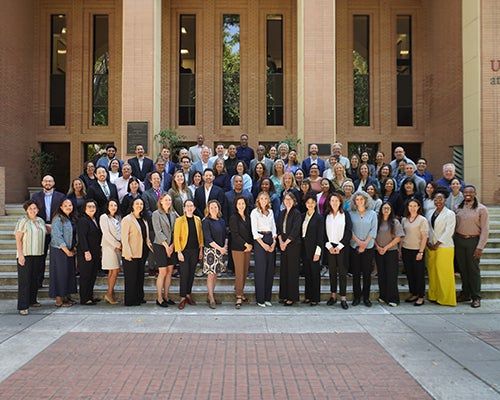
A small group of scholars I work with has been trying to elevate the role of the superintendency and the importance of the superintendent for student learning. In 2023, the Annenberg Institute at Brown University had a convening focused on superintendent research, but it only included researchers like me. As a faculty member, I’m usually traveling two or three times a month to be in the field with superintendents. So, I wanted to bring researchers together with superintendents, organizations that support superintendents, philanthropic organizations, and graduate students and postdocs who will keep this work going.
The convening was an opportunity to gather smart folks to think about the research challenges, and even with the challenges, how we can design and implement robust studies around the superintendency that can inform shifts to leadership preparation, superintendent support systems, and state policy.
You presented a flash talk at the convening on your forthcoming research. What was your topic?
Predictors of contentious turnover. One of my big findings is that the gender of your superintendent is among the most significant predictors of whether your district is going to experience politically contentious turnover, holding constant historical student achievement growth. If you’re in a district where student growth is stagnating or declining and you have a woman superintendent, you have about a 33% chance of experiencing politicized turnover, nearly nine percentage points higher than comparable districts led by men. But in historically high student growth districts, there was no gender gap in the likelihood of contentious turnover. Some of my other research shows women are more likely to serve in districts that have either stagnant or declining student growth and where student achievement has been below state or national averages. This new piece is, to my knowledge, the first to truly test the glass cliff
concept: Were they more likely to be pushed out of those positions quickly and in a politicized fashion? This new research documents that.
That’s a fascinating finding. So, will you organize future convenings?
We’re planning to do the convening every two years, which allows us to provide updates on research that has emerged between the convenings. The next one will be around AERA in Philadelphia in April 2028.
Meanwhile, alongside your scholarship, what courses do you teach?
My primary teaching responsibility is for the Cooperative Superintendency Program, which is our education doctorate program for aspiring district leaders and superintendents. Every fall, I teach the school finance class and every spring I teach a course on superintendent-school board relations. In our Education Policy and Planning master’s program, I teach school law. I also teach a superintendent seminar for our students as they’re finishing their coursework and moving into their comprehensive exam in their dissertation proposal.
Speaking of teaching, what do you love about working at COE?
I don’t think there’s another place in the nation where what I study, what I’m doing in the field, and what I can bring into the classroom would align so well. The CSP program is special; we just celebrated our 50th anniversary. When I teach school board relations, I approach it through case study and simulation. Growing up, I was a basketball player and my coach used to say, You should be able to make free throws with your eyes closed because you’ve shot enough to have developed muscle memory.
Through simulation and case study, my hope is that when leaders get into a politicized situation with their board, they’ll have the muscle memory to navigate it efficiently and effectively so they can get back to focusing on leading for student learning.
That’s what I love the most—being able to translate what I see in the field and in research directly into curriculum development and apply it with innovative pedagogical approaches. Being able to innovate is fun, and I love that teaching is a creative endeavor.
What else is keeping you busy?
Over the last year, I’ve co-developed three online simulations to help superintendent political leadership skills. One is around school discipline and another on school closures. A third simulation on labor relations is coming. Being a superintendent requires a lot of knowledge and skills, but also specific dispositions. In the classroom, through these simulations, I try to get students to feel what they’re going to feel in the workplace. We also want people to take these simulations to their school districts. It can be good to say to your central office team or school board, We’re not in a school closure situation, but three or four years down the road we might be. Why don’t we simulate it now to understand how we’re going to make decisions?
We’re hoping that people take the simulations to their own districts and that everyone can access them.