
As artificial intelligence brings changes to the classroom and workplace, a College of Education scholar is preparing high school students to directly examine its ethical challenges and opportunities.

This summer, Jason Rosenblum, assistant professor of instruction in the Department of Curriculum and Instruction and assistant professor of instruction with the McCombs School of Business, partnered with the online international School of Humanity, which serves 170 students ages 11 to 18 from more than 40 countries. He supervised advanced internship projects exploring the ethical applications of technology and the impact of AI systems on learning and workforce development.
AI is a tool,
Rosenblum says. It’s up to us to figure out what it’s good—and not good—for.
Rosenblum is a learning technologies educator focused on innovation and the ethical design of emerging technologies, particularly generative AI and human-centered technology integration in education and business. He also serves as co-editor-in-chief of Artificial Intelligence in Education, a peer-reviewed publication featuring original research on educational applications of AI.
He designed the internship around principles that place people—not technology—at the center of learning. Drawing from strategies that inform the Learning, Equity, Action and Design Stackable Certificate he leads at the College of Education, the program is built around one guiding question: How can AI be used to enhance, rather than replace, human cognition, agency and equity?
Ethical Frameworks
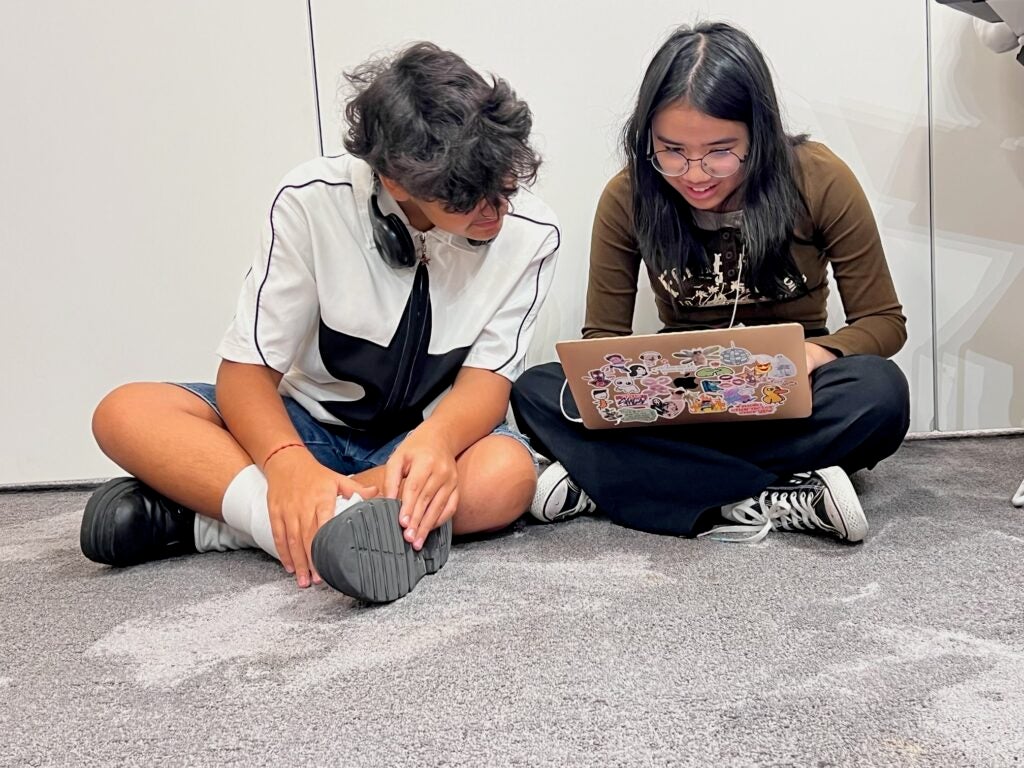
Of the program’s 36 high school sophomores and juniors, 10 students participated in a group known as Cohort Pluto. Divided into two teams, they explored how AI is shaping education and the future of work through a structured ethical framework.
The first team examined the role of ethics and AI in teaching, learning and student outcomes, producing a video, The Rise of AI in Education, while the second assessed AI’s implications for workforce readiness, professional practice and the future of work.
Because there is no single agreed-upon standard for discussing and researching ethical AI, Rosenblum combined several existing frameworks, including those from UNESCO, into five commonly cited areas of emphasis: agency, cognition, equity, transparency and long-term impact.
These principles help determine whether users remain meaningfully in control; whether AI deepens or replaces human thinking; which populations may be excluded from its benefits; how transparently AI systems influence outcomes; and the long-term effects the technology may have on learners and the workforce.
Students at the School of Humanity are exploring what it means to use AI effectively and responsibly,
Rosenblum says.What’s critical is applying your knowledge not only to use AI but also to understand when and how to constrain and govern its use.
Melina Maghazehi, a learning facilitator at the School of Humanity, says she enjoys seeing learners enhance their research, presentation, teamwork and critical thinking skills. They were given an opportunity to engage directly with an expert in the field, ask important questions, and gain a deeper understanding of the real-world implications of AI,
she says.
Rosenblum notes that many of his interns took a more cautious approach to AI. Rather than using it as a super version of Google on steroids,
he says they are often reluctant to rely on AI for tasks that require critical thinking and are concerned that cognitive offloading could undermine their work.
As an instructor, I want to conduct authentic assessments,
Rosenblum says. I want students to apply concepts and knowledge as they build, create and solve problems. Nothing about that changes—or should change—when we incorporate AI.
Preparing For an AI Workforce
By the time today’s students enter the job market, it will likely be transformed by an AI-enabled and AI-empowered workforce. Rosenblum believes that using AI effectively to help solve real-world problems in an ethical and transparent manner will be the greatest advantage.
The application and use of AI is not simply a tool-related problem,
Rosenblum says. It’s a pedagogical, thinking and learning problem. AI literacy is about more than teaching people how to use the tools. We need to develop strong academic practices that prepare students for higher education and workforce readiness.
Rosenblum cautions against viewing AI itself as the primary threat to employment. While the technology is reshaping workplaces, he argues that many workforce reductions are the result of business decisions concerning AI adoption and implementation.
To invest in AI, many businesses need surplus revenue to invest in that infrastructure and are looking for ways to reduce costs,
he says. Human capital is often their largest expense. While some companies are certainly choosing to reduce their workforce, that doesn’t mean that AI is
taking over
the job market.
Rosenblum adds that some executives are making good choices implementing technology, including Nvidia Corp. CEO Jensen Huang, who recommends that employees lean in
to the moment.
One of Rosenblum’s beliefs concerning the future workforce echoes an observation from Huang: People may not lose their jobs to AI alone, but they may lose them to someone who knows how to use it. It’s a key message he conveys to his students concerning the critical nature of AI literacy and ethical use, both now and in the future.